79th Infantry Brigade Combat Team (California National Guard)
Temecula, CA
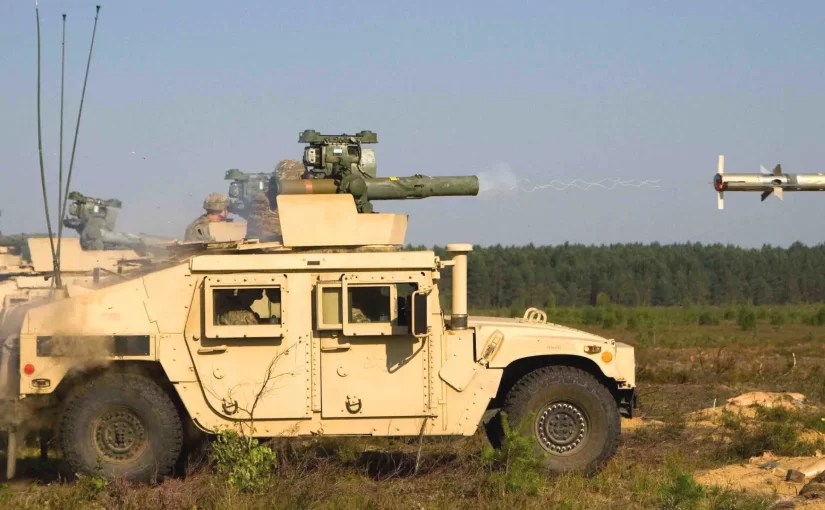
They set their ambush where I-15 crossed over Rainbow Valley Boulevard. The 15 crossed over the surface street via a large cement bridge. Once the bridge was blown, the Chinese armor units would be forced to take the much smaller Old Highway 395. The old highway was only two lanes wide and had a large bluff on the right side. Perfect for hiding missile teams and their vulnerable HMMWVs. As a guard unit, the 79th, was most commonly involved in civil disturbance or disaster relief work. They were not armed with tanks or armored infantry fighting vehicles. They had plenty of TOW missiles, however. The venerable missile had been liberally deployed into guard units and the 79th had a dedicated anti-armor company.
“Bear One One, Bear Two Two.”
Colonel Banguey picked up a tactical radio. “Go for Bear One One.”
“Sir, we have multiple Chinese tanks coming up the 15. I count twenty so far. Looks like a full battalion, support vehicles, the works.”
“Copy. Are they moving into civilian areas at all?”
“No sir. They seem to be securing the freeway as they go. IFVs blocking all the onramps and offramps as they go.”
“Copy, keep me posted.” The entire area was devoid of civilian traffic anyway. The army had ordered all civilians to evacuate north two days before which had caused a massive traffic jam. It had taken almost two days to get the majority of civilians clear. There were plenty of civilans trapped behind enemy lines in San Diego. Banguey had no idea where his own family was. Something he made an effort not to think about.
“Roger that.”
Banguey turned to the soldiers behind him. “Launch two switchblades.” The Switchblade 300 had entered service very late in the Afghanistan conflict and had quickly proven to be a soldier’s best friend. The “loitering munition” allowed a single soldier to launch a weapon that could surveil a target, attack it or abort the attack if there were friendlies in the area. While the 300 series the 79th was carrying wouldn’t take out a tank, it would easily destroy a lightly-armored vehicle like a SAM launcher or radar. The plan was to use the drones to scout out the Chinese armor column and then attack the radars supporting their SAMs. Ideally, this would make the air support they expected more effective.
“Any word on air support?”
“Working on it, sir. They are currently engaged supporting the 221st up in Palm Springs right now.”
“Dammit, where are the regulars? Are we going to fight this war completely on our own?”
There was no answer to this question.
With an angry shake of his head, he looked over the operator screen from one of the Switchblades. The Chinese forces were coming close to the bridge they had wired with explosives. “Bear Three Two, Bear One One.”
“Go for Bear Three Two.”
“Blow the bridge on my mark.”
“Ready.”
Banguey waited. He let the scouts pass across. There were three tanks approaching the bridge. Wait for it. Wait. “NOW.”
“Fire in the hole!”
The rumbling BOOM of the explosion reached his position a few seconds later. The screen just showed a cloud of dust for a few seconds. When it cleared, he could see two tanks inside the hole where the bridge had been. Another was sitting flipped over on the freeway. “Good effect. Retreat to your fallback.”
“Bear Three Two, moving.”
Watching the Chinese react to the ambush was impressive. They quickly assessed the situation, deployed troops to check for more explosives and established an alternate route via Old Highway 395 within ten minutes. All during this exercise, the troops of the 79th stayed hidden in their prepared positions. The goal was to slow them down. There was no way that the 79th would win a straight up fight, but they could slow them down to a crawl and that’s what Banguey intended to do.
Several Chinese IFVs joined up and led the column down the old highway. “Bear Three Three, Bear One One.”
“Go for Bear Three Three.”
“Coming your way. Shoot and scoot.”
“Yes, sir. Shooting and scooting.”
The HMMWV-mounted TOW weapons streaked down onto the column which had been forced into a narrow line due to the steep bluff beside the highway. Fifteen missiles were fired in the initial barrage. Twelve of them hit their targets. Most of the crews made it to their fallback position safely. The Chinese tanks instantly opened fire on the hillside where the missile crews had been stationed. The hillside erupted in gouts of rock, soil, dirt and smoke which billowed into the blue California sky.
Again, the Chinese column stopped. Again, the Americans waited under cover. Ironically, almost every member of the brigade had been on the other side of asymmetric warfare like this. They had been sniped at, blown up and otherwise harassed in Afghanistan and some had even served in Iraq. The insurgents mostly used IEDs, not guided missiles, but the concept was the same. They hadn’t intended to learn these tactics for themselves, but they knew exactly what a small force could do to slow down larger force. They were using these hard-won lessons now.
Banguey turned to Command Sergeant Major Selston. “Any word on getting a JTAC up here?” Joint Termina Attack Controller (JTAC) was the term the US military used for ground controllers who were trained to call in air strikes.
“No sir, no joy with command. Comms are still fouled up, no SatCom at all.”
Banguey watched the overhead imagery as the Chinese once again got organized. He picked up a tactical radio. “Charlie Battery, Bear One One – Fire mission, grid four six one seven, anti-tank mines in advance of column. Direction one nine zero zero.”
The tinny voice of the artillery battery came back over the radio. “Charlie battery copies. Fire mission, anti-tank mines.”
A few moments passed. “Shot out.”
Everyone in the hastily assembled command bunker heard the ripping linen sound of 155mm rounds passing overhead. “Splash.”
“Rounds on target, end of mission.”
“End of mission, out.”
While not commonly used by the US Army, artillery-dispersed mines are one of the most effective ways to slow down an advancing armor column. The mines were deadly to any tracked vehicle and could not be simply ignored by the oncoming troops. They could be cleared, but that took time.
Banguey returned to the radio. “Bear Four One, Bear One One.”
“Go for Bear Four One.”
“Say status.”
“I have sixty, say again six zero, armored units visible from my position. I have good overwatch and I am ready to illuminate.”
“Confirm six zero. Commence illumination. Hit the lead tanks of the formation, slow them down.”
“Target illuminated.”
While the 79th didn’t have many of them, it did have a supply of M712 Copperhead guided munitions. Using a laser designator, the troops stationed above Banguey illuminated specific vehicles to give these specialized shells a very precise fix on their targets.
“Charlie Battery, Bear One One – Fire mission, grid four six two eight, Copperhead strike on tracked vehicles. Direction one nine zero zero.”
“Charlie battery copies. Fire mission, copperhead, target tracked vehicles.”
And so it went. Several tanks exploded as the Copperhead rounds penetrated the thin armor on their turrets and cooked off the ammunition inside. Banguey was feeling pretty good about his position until the aircraft arrived. “INCOMING!! DOWN! DOWN! DOWN!”
144th Fighter Wing (California Air National Guard)
Flight Level 40, Cajon Pass, CA
After finally breaking radar lock from the Chinese SAMs, Colonel Paulson was beginning to relax a little when he heard the urgent calls for support from the 79th Brigade. He consulted the map strapped to his thigh. That’s only fifty miles away. He looked to his right, his wingman was right there where he was supposed to be as Paulson led the wing down through the narrow Cajon pass. The top of the pass was about 3,700 feet. Their current altitude of 4,000 feet was only three hundred feet from the rapidly rising I-15 as it passed through the San Bernadino mountains. It was only the relatively mountainous terrain that had saved them from the Chinese SAMs still lurking just to the south and west. He was headed away from the 79th. That would be quickly remedied.
“Phat One One to wing. New target, we have troops in contact, Grid Two Six Five. Spread four formation. Pick your targets until you are Winchester, then RTB.”
The quick radio call was a risk, but he had no other way to inform the wing about his plans. With a gesture to his wingman, he flipped his F-15C straight up and punched the burners again. Continuing to pull back on the stick, he did a full 180 vertically and then flipped the plane over again with a quick aileron roll. As he gained altitude, his radar showed him the contacts. From their radar signature, they looked like J-10s which were similar to the USAF F-16 and had a similar job.
He targeted the closest two and squeezed off his last two AIM-120D missiles. He didn’t have time to admire the flight of the missiles because his threat receivers started going nuts. radar transmitters were going on all over the I-10 and I-15 corridors. One had locked onto him. “SAM SAM SAM. SAM LAUNCH, six o’clock.”
He swore to himself and once again dived for the safety of the narrow mountain canyons. His wingman wasn’t so lucky.