221st Cavalry Regiment (Nevada National Guard)
Cabazon, CA
Lieutenant Colonel Aliston studied the maps intently. He was in a relatively good defensive position here, but also extremely exposed with essentially no backup available to him and no reloads. He had plenty of fuel thanks to the multiple truck stops along I-10 in the area. He had taken the simple expedient of ordering all diesel pumps shut down and had declared martial law to enforce the order. They had fuel to spare. They also had the entire command team set up inside the massive parking structure of the Morongo Casino, hiding them from aerial surveillance. The casino was completely empty of civilians. Aliston’s first act had been to declare martial law and close down all civilian businesses in the area. So, they had a secure base and civilians were out of immediate danger. What they didn’t have was air cover.
“Sir, I have the 144th on the horn.”
Finally. “Wildhorse, actual”
“Phat, actual.”
“Phat, I need overhead, and I need it quick.”
“Sir, we moved to F-15 Charlies last year.”
“Dammit, we are about to be in a world of hurt down here.”
“Understood, we have one squadron of F-16s down at March, we will get them spooled up for you but we’ve also got the 79th down on I-15 asking for help also.”
“Don’t we have an Air Battle Manager assigned?”
“Not yet.”
“Kick your command in the ass, son. We are going to have troops dying here.”
“Yes, sir.”
The chaos caused by the meltdown of US military communications satellites and related systems was going from serious to deadly. Without the ability to coordinate their forces, there was no way to fight a combined arms engagement. Each unit was functionally operating on their own, which was not how they were supposed to fight. The US military fought as a unit, each team supporting every other team. A calvary regiment like this one wasn’t supposed to be able to defend itself from airborne threats. It relied on the Air Force to do that.
“Ziffren! Do we have those scouts in place?”
“Yes sir, I have a squad up on top of San Jacinto. They took the tram up. I told them to keep the cars locked down, so they don’t get visitors.”
“Good thinking. I want regular reports.”
“Yes, sir.”
Walking over to where the HMMWVs were kept, he signaled to his driver. “Take me down to the defensive line, I want to see those revetments.” Unlike his time in Afghanistan, there were plenty of locals who were willing to help. When the call had gone out for earth-moving equipment, two dozen front-end loaders had shown up in less than an hour. One from a guy purporting to run a local dinosaur museum. Aliston had spotted a hand-painted sign on the side of the freeway reading “ROBOTDINOSAURMUSEUM” in red lettering with no spaces. The dinosaur guy and the other volunteers had spent the entire day moving sand around the desert. Each of the eighteen tanks under his command had four different protected revetments dug out on areas of higher ground. This would allow them to command the entire twenty kilometers of the pass. Until the ammunition ran out. Aliston didn’t think much past that. He knew what “at all costs” orders meant. Even when out of ammunition, the tanks would not retreat. His entire unit would die to the last man, if needed. Enough of that—work to do. He chose to think about I Corps and the wealth of ammunition and reinforcements that they would bring.
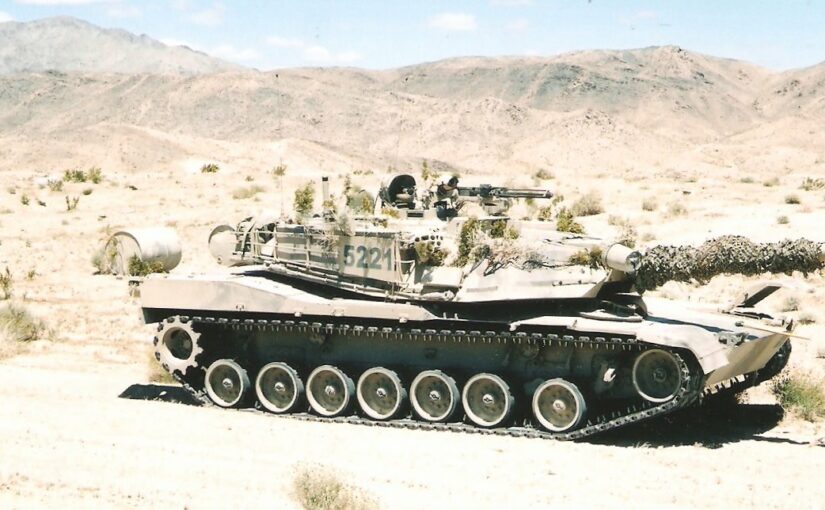
It took him several hours, but he was eventually able to inspect each M1 team and most of the Bradleys. The plan was to place the M1s out front with the Bradleys behind providing missile support from relatively long range. The M1s could survive close contact with the enemy so they would be in the fore. Bradleys would be sniping. While the 120mm L4 smoothbore on the M1 had about the same two-mile range as the TOW missile on the Bradley, the TOW was a guided weapon and tended to be more accurate at long range. Within 2,000 yards, the M1 firing M829A4 armor-piercing fin-stabilized discarding sabot (APFSDS) rounds was deadly even against the most modern tank. The Javelin missile teams in the hills would hold off to avoid giving away their position until the situation was dire enough to merit their support. Although their range was only about four kilometers, the varied terrain allowed him to spread the teams out and get very good coverage. They would also be attacking from above which gave them another advantage.
Taking the elevator up to the top of the Morongo Casino Tower, he worried about artillery. He would be a sitting duck on top of the astoundingly ugly casino tower but it was literally the tallest thing for miles around. Without overhead imagery, he needed to see what was going on and the top of the tower was his best bet. Walking out onto the roof, he felt amazingly exposed. Nothing for it. He carefully scanned the positions he could see from here. None of the vehicles were visible. All of them had been carefully concealed from overhead surveillance. They had seen several drones flying around and had assumed they must be enemy surveillance drones.
The tactical radio crackled. “Enemy armor sighted. Moving up I-10. Type 96 tanks, type 4 IFVs, assorted support vehicles. Estimate brigade strength. Light scouting elements ahead of the main column about a mile.”
“Are they detouring into the populated areas at all?”
“No sir, they look to be securing the freeway. I see IFVs at each onramp, blocking access.” There was a pause. “They look more like MPs than troops, sir. Personal weapons, machine gun on the IFV. No missile tubes I can see.”
“And the main column?”
“Packing heavy. At least fifty tanks and as many IFVs. Looks like two companies of artillery, they look like those French CESARs, so PLC-181s?” The Chinese had been phasing out towed artillery in favor of self-propelled guns like the PLC-181 which was a 155mm self-propelled gun. Bad news for the defending Americans.
“All teams, plan Bravo. Say again Bravo. ROE Alpha in effect.”
Aliston let them come ahead. The Americans were hugely outnumbered. The longer they could avoid a Chinese artillery barrage, the better. So, he waited. And waited. After he had plenty of time to consider all the bad life choices that had led him to this point, he finally saw the first scouts coming down I-10. “Enemy in sight. Hold fire.” Still, he waited. They had carefully plotted their optimal ranges from each pre-set firing position. The mobile artillery units were in the middle of the column. He wasn’t going to get them all, but he wanted the first barrage to take out as many of the mobile guns as possible. Artillery was still king of the battlefield. Those guns needed to be taken out or this battle would be short and bloody. “On my mark, target the mobile guns.” Just a few more seconds. Now. “Alpha, open fire.”
Even though he was over a mile away from the nearest M1, he could see and hear the mighty 120-millimeter cannons opening up. Huge tongues of flame shot from each tank as one by one the computer targeting system calculated the precise firing angle. Firing at soft targets like mobile guns, they were using High Explosive (HE) rounds. Each one made an impressive explosion and another wave of sound as they hit their targets. Within a minute, the Chinese tanks were firing back, mostly striking the berms the M1s were hiding behind, but several shots ricocheted off of the thick Chobham frontal armor of the tough American tanks. “Bravo, engage those tanks.” At this command, the Bradleys started volleying off their TOW missiles. Each one would “shoot and scoot”, knowing that Chinese counter-battery fire was sure to come. Within seconds, the Chinese tanks started taking losses. Then the Chinese missile carrying IFVs engaged. Missiles criss-crossed the small valley turning the desert into a killing ground. The Chinese were taking losses, but not enough to stop them. The lead elements were coming dangerously close to the prepared positions of the M1s.
“Alpha, shift to alternate revetments.” With that, the sixteen surviving M1 tanks reversed hard and moved to their backup position. The turbine-powered M1 could move astoundingly fast for such a large vehicle. One of the tanks was caught between positions and hit with a round fired from one of the lead Chinese tanks. “Charley company, open fire.”
Finally, the Javelin teams hidden on the hillsides started to fire. Again, they had carefully sighted their positions and only fired on units within 2,000 meters of the lead M1 positions. Within 30 seconds, there were no operational Chinese vehicles in that kill zone. Just when Aliston felt like he might survive the engagement, the call he had been dreading came in. “Choppers! Enemy helos coming up the valley.”
“All units, shift your positions and take cover. Enemy air coming in.” He turned to the two stinger-equipped soldiers behind him. They only had a dozen missiles total. “Make those shots count.”
With a deep booming stutter, the six Chinese Z-10 helicopters came around from behind San Jacinto mountain and made their way towards the Americans. “Hold your fire. Wait until you have a clean shot.” He held his hand up. “Wait….. wait… FIRE!” With a high-pitched whooshing sound the two missiles streaked out, towards the enemy helicopters. One missile hit, one missed. As the soldiers hurriedly reloaded, the helicopters turned towards the tower, tilting forward to maximize their speed. “They’ve seen us!” Both two-man teams prepared another launcher, the lead shooter for each taking aim. A pregnant moment passed as the launchers acquired. With another whoosh, two more missiles streaked out, each striking a helicopter.
By then, the building was in range of the remaining three helicopters. Two helicopters fired two missiles each at the rooftop. “INCOMING! DOWN! DOWN! DOWN!”
144th Fighter Wing (California Air National Guard)
Flight Level 30, Redlands, CA
Colonel Paulson listened with growing concern to the ever more urgent calls from the 221st. The last two days had been nothing but frustration for him and the other members of the wing. With communications fractured and normal procedures not working, the wing was largely on their own. This was not how they were supposed to fight. They were supposed to be tightly integrated into a larger joint command with a specific officer assigned to direct the overall air battle. In the chaos after the space-based bombardment and the jamming still affecting communications, normal procedures had been thrown out the window. He had talked directly to the commander of the 221st and had decided on his own to commit his wing to support the beleaguered defenders.
Unfortunately, what they really needed was a Wild Weasel mission and none of his aircraft were currently configured for that mission. His F-15C could detect the enemy radars searching for his wing just across a line of hills from his current position. He was only at 3,000 feet but he planned to go much lower. Ground level here was about 1,300 feet. As he got lower, the altimeter wouldn’t matter. He would see the rock that killed him just before impact.
The plan was for the squadron of F-15Cs he was leading to come in low and fast, take out any aircraft in the area and then allow the F-16s following to do a ground-attack run. They were equipped with cluster bombs and only limited IR guided air to air missiles. Of course, that meant that the F-15s would be completely exposed to any SAM fire that managed to target them in the short time they would be over the target. Paulson reached down and armed his six AIM-120D missiles. Looking over, he gave his wingman a thumbs up which was returned. No radio traffic helped increase the odds that they would arrive without prior notice to the Chinese.
Pushing his throttles to the stops, he engaged the afterburners and pushed the stick down. In seconds he passed Mach 1, flying at 200 feet Above Ground Level (AGL) over I-10. Easing the stick back slightly, he crested the Yucaipa Grade at less than 50 feet—he could read the road sign indicating the exit for Yucaipa boulevard. He was completely focused on the task. Any slight mistake on his part would be instantly fatal. This kind of low and fast approach was normally an attack-aircraft pattern, but they all practiced low-level tactics at places like Jedi Transition out in the desert of California.
Screaming over Cherry Valley at over 900 miles an hour, he quickly came up on the final rolling green hill masking him from the Chinese division. Reefing his fighter into a punishing 9G turn, he grunted with effort as he turned again to parallel I-10. He could easily see the casino that the 221st was using as a command post. It was a gigantic ugly spire in the middle of nowhere. Just as the building came into view, he saw several explosions rip the top of the building off. “Shit!” Just as quickly, his radar detected aircraft just beyond the building. He quickly rippled off two AIM-120Ds and he could see from the corner of his eye his wingman do the same. They had no time to set up a proper attack, they were coming in way too hot. Exactly what he had been trained not to do under any circumstances. Before he could take stock of the situation he was past the casino, flying below the top of the building. Coming out of his turn, he could look down Coachella Valley towards Palm Springs. He could easily see Chinese tanks rolling down I-10, but there was nothing he could do about that.
Suddenly, his radar threat receiver went off, a dire tone that told him he was in extreme danger. Down on the deck like this, he had very little room to maneuver so he chose to just head straight towards the radar. Close the distance fast, before they can react. Almost as an afterthought he fired off a couple hundred rounds from his onboard cannon. He had no idea if he was hitting anything. His radar picked up Chinese aircraft off in the distance. They were only about ten miles away but his AIM-120Ds were hampered by his low altitude. He waited a few seconds for the range to reduce. In seconds, he was over the Chinese column, and past them, still on full afterburner. If anything, he was even lower. He had to pull up a few feet to dodge the overpasses across the freeway then went back down once past. He was taking insane risks, but speed and low level were his only chance. Coming to the end of the Coachella Valley, he again pulled into a high G turn, but to the left. Turning the corner, San Jacinto Mountain masked him from the enemy SAM launchers and his threat receiver muted down. Total time exposed to Chinese SAM coverage: three minutes. He was sweating like he had run a marathon.
“Phat One One to Phat Two One. Watch yourself, those SAMs are alerted to your presence. They are lined up on I-10, align your attack to the freeway.” Pulling up hard, he targeted the two Chinese planes he could see on his radar, fired off two more AIM-120Ds and quickly dropped down again into the valley behind Joshua Tree National Park. Four missiles expended, he and his wingman were completely untouched.
The follow-on squadron of F-16s were not so lucky. Half of them were shot down but they managed to drop an even dozen cluster bombs right onto the Chinese SAMs. Paulson had no way of knowing, but his mission was a success. All the attacking helicopters had been downed by the F-15s and the Chinese fighter aircraft had abandoned their planned attack on the American position, at least for the moment.