Salton City, California
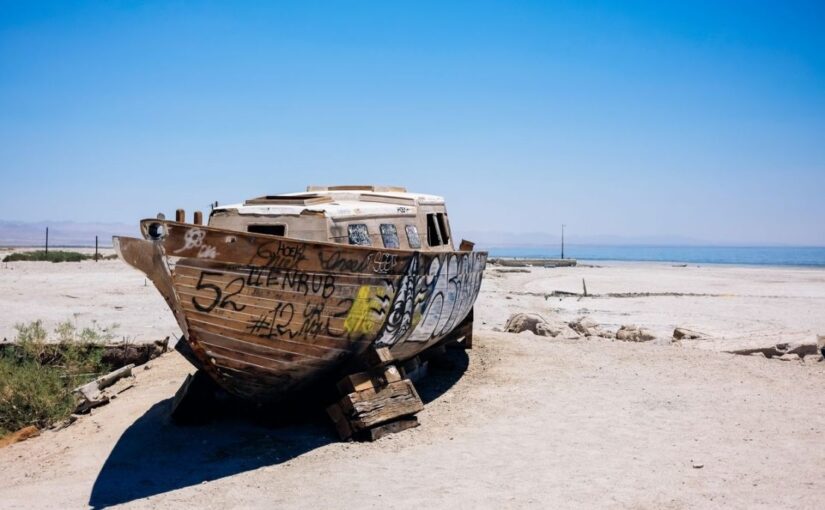
Lance Peters sighed as he opened a beer on the back porch of his trailer. Sitting down on the lawn chair, he gazed over the salt flats of the former Salton Sea. For some reason, he felt like he belonged here. Semi-abandoned, only crazy people lived here these days. Decent folks, they kept to themselves which suited Peters just fine.
After the South China Sea war, Peters had bounced around the Army in a couple of roles. Too old for a field command, his final posting to the Pentagon convinced him to leave the Army for good. However, once he left, he realized he really didn’t have any marketable skills or interest in working for a company that made widgets or whatever it was they did. After trying to run an executive consulting company focused on motivation and strategic goal setting, he finally decided to simplify his life. Living in a trailer on his Army pension in a mostly abandoned town was about as simple as it got. He didn’t even have a phone or electrical service, just solar and water he had delivered once a month. Or at least he had water delivered when he remembered to pay the bill, which he hadn’t lately.
Living in the desert meant that you didn’t have to weed the yard, just an occasional raking was fine. No trees or grass to maintain. Just sand and rocks.
As he finished the beer, he was faintly surprised to hear a car drive up his driveway. In the year he had lived in the trailer, he had had exactly one visitor, someone from the local veterans hall worried he was a suicide risk. Since then, nobody had come down his street, let alone come up the driveway.
A patient man, Peters waited. If it was someone who wanted to talk to him, they would figure it out. If not, he’d rather not talk to anyone anyway.
A few seconds later, the car stopped, the engine was turned off and he heard a door slam.
“Captain Peters!! Are you home?”
Well, shit.
Peters didn’t move. Perhaps the person would just go away.
But they didn’t go away. “Peters! Godammit! Are you here or not?” He heard knocking on the door of the trailer.
Peters briefly entertained answering the door. But then he remembered he had another beer in the cooler by his foot. Opening the beer, he decided that the door would take care of itself.
A minute later, a tall Asian man walked around the side of the trailer. “Captain Peters! Is that you? Jesus Christ! You look like shit, man.”
“Retired.” Peters sighed. “I don’t know you, man; this is private property. Go the fuck away or I get my gun and shoot your ass.”
The man shook his head and walked over to where Peters was sitting. “Don’t you recognize me?”
Peters took a good look. The man looked Korean. Fuck. “No, did I shoot your mommy during the war or something?”
“I heard you had some sort of breakdown, but I didn’t think it would be this bad.” The man looked around for another chair but didn’t find one. He walked over and leaned against the post holding up the awning. “Peters, it’s me, Dae-Won Park.”
Peters looked at him again. “All the Koreans I know are dead.”
“Well, you missed one.”
This dude wasn’t going to go away, was he? “OK, I give up, who the fuck are you?”
The man shook his head. “You really don’t recognize me?”
Peters took a big slug of the beer. Maybe the alcohol would make him go away. “No, go the fuck away.”
“Dark barn, greedy general, sea route home?”
Peters dropped the beer and leaped to his feet. “Park! Holy Fuck!” Park flinched as Peters gave him a huge bear hug. “I thought you were dead, man!” For a moment, Peters was back in North Korea, behind enemy lines just days before the invasion from the south. While he had been too focused at the time to be afraid, he looked back on that time now with a shudder. So many things could have gone horribly wrong.
Park laughed. “No, just stuck behind the line. I got trapped halfway to the ocean and missed my ride. Got a bit hairy there for a while. By the time I got clear, the war was over.”
“I would offer you a chair, but I’ve only got one.”
“You OK, man?”
“Yeah, just needed to simplify things.”
Park looked around. The ancient aluminum trailer had been painted once but was mostly just bare metal now. Inside it looked like someone had put curtains in the windows sometime in the 1950’s. It was hard to tell because the windows clearly hadn’t been cleaned since then. If his source hadn’t insisted that Peters was here, he would have assumed the trailer was abandoned.
“How about I buy you dinner?”
Peters shook his head. “I don’t get out much. I’m fine here.”
Park poked his head inside the trailer for a second. “They have a bar there.”
“Well, that sounds more interesting.” Peters sighed. “I don’t do well around crowds.”
“It’s 2pm on a Thursday. There won’t be anyone there.” Peters still looked doubtful. “We can eat on the patio. You don’t need to go inside.”
Peters laughed. “OK, you got it.” He looked down at his ragged T-shirt and dusty jeans. “Uh, let me put on some fresh clothes.”
“A shower wouldn’t hurt.”
“No water.”
“Of course.”
By the time they made it to the Jackalope Ranch restaurant in Indio, Peters was getting curious about why Park had gone to so much trouble to find him.
Settled at a table on the edge of the lush grass and listening to the artificial waterfall just on the other side of the artificial pond, his brain started to engage again. “OK, Park. What the fuck is up?”
Park laughed and sipped at his mai tai. “You’re an asset, my friend.”
“An asset?”
“Yeah. You are well trained, an expert in austere operations and, judging from our time together today, nobody will miss you if you suddenly disappear for weeks or months at a time. You would be surprised at how many people can’t just drop everything and leave the country.”
“I would?”
“You just going to ask two-word questions all day?”
“I might.”
“Fuck man, cut it out.”
Luckily the slab of ribs they had each ordered arrived just then. Peters tore into his with ravenous hunger. He realized it was the first decent meal he had eaten in months. He’d been living off of canned food and Top Ramen packets. It tasted pretty fucking good.
“OK, Park, tell me what the fuck is up. I don’t know you well, but our brief time together didn’t lead me to think you are sentimental. We are not going back to Korea, that shit is all wrapped up. There is no way the Army wants me, or you would be wearing a uniform and pretty ribbons. This isn’t a social call because I don’t actually know you. Don’t give me that spook central shit. You have a job for me. What is it and will I survive the experience?”
Park paused over his second to last rib. “That’s more than you’ve said to me all day.” He finished the rack, opened a wet wipe and carefully cleaned his hands and face. “Let me tell you about a lovely estate the CIA owns in Nogales, Mexico. You will love Sonora, I guarantee it.”
Peters started to laugh. In seconds he was laughing so hard his eyes watered and he struggled for breath. Finally, he stopped, panting. “OK, you got me.”
Continue with Episode 2 NOW!