90th Fighter Squadron
Joint Base Elmendorf–Richardson, Alaska
“Sir, Sentry is reporting multiple aircraft over the East Siberian Sea. Multiple Midas-class tankers and radio chatter consistent with refueling operations.”
Lieutenant Colonel Roger “Amazing” Grace and the rest of the 90th Fighter Squadron had been going quietly insane ever since the attacks on the US mainland. For unknown reasons, the Chinese had completely ignored Alaska, leaving the 3rd wing as one of the few completely intact and operational units for the US Air Force in North America. They had fully expected to deploy south to support the defense of the continental USA (CONUS) and had immediately started “Rapid Raptor” planning to get their support units deployed with them. However, no orders had come. The deafening silence from upper echelon command was eerie at first, then annoying. Almost all of their parent command, Pacific Air Force, had been wiped out during the attack on Pearl Harbor which had also hit Hickam (part of joint base Pearl Harbor-Hickam) very hard. However, the 11th Air Force, headquartered at Joint Base Elmendorf-Richardson had survived completely intact. The problem was that they had been given no mission to perform.
Until today. “Scramble the squadron.”
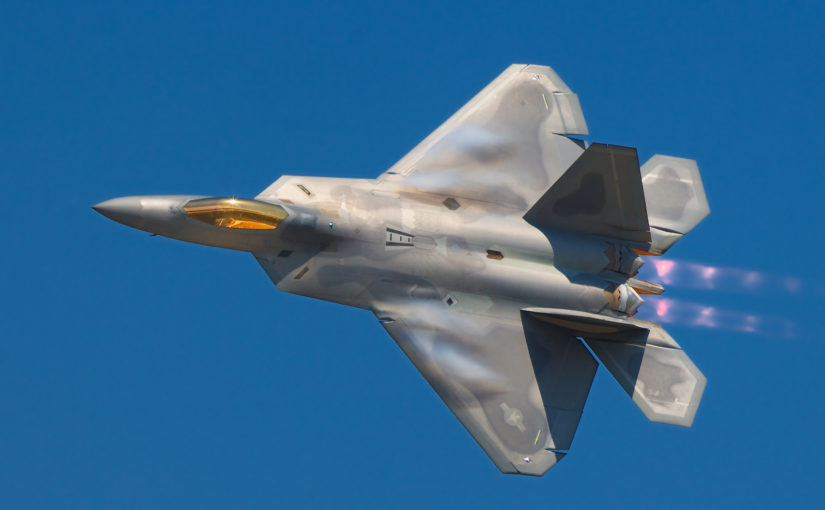
The F-22s of the 90th had been sitting fully armed and fueled for days, ready to go. Pilots had been on alert status since the original attack. They had been allowed to sleep if they could, but they had been trapped in their ready rooms for days. Now they ran to the crew vans which raced out to the flight line. Crews urgently pulled last minute safety pins, visually inspected each plane and prepared their planes for takeoff.
Grace signaled to his operations chief to follow him into the crew van. As the van sped to the flight line, he leaned over to speak into his ear. “Did that E-11 head down south yet?”
“No, sir.”
“Get the general on the horn, let him know I want that bird ASAP.”
“Yes, sir.”
The E-11A Battlefield Airborne Communications Node (BACN) was one of the rarest aircraft in the USAF. A heavily modified Bombardier Global 6000 business jet, it was basically a flying communications node. It was completely unique because it allowed almost any voice or data network in the US military to talk to almost any other voice or data network. For the F-22 this was vital because of the completely unique Intra-Flight Data Link (IFDL) the F-22s used to talk to each other was not supported by any other aircraft including the F-35. Older aircraft used systems like Link 16, but those systems were not stealthy and could not be used on a stealth aircraft like the F-22. The F-35 had a similar system called MADL, but it wasn’t compatible with IFDL. BACN bridged all these systems, but there were only nine of them total in the USAF inventory. Luckily, one had been assigned to Elmendorf for Red Flag-Alaska.
Making it to the flight line and his assigned F-22, Grace trotted over to his crew chief and gave him a fist bump. “Ready to fly?”
“Ready sir, fully armed and fueled. Checks done, pins pulled, ready to rock and roll.” The plane captain offered a salute, which Grace returned quickly. He briefly trotted around the aircraft, shortening his normal ten minute pre-flight to just a few seconds. He trusted the ground crew, but a last-minute eyeball was worth a few seconds on the ground. All the safety pins had been removed, and all the covers were off the inlets. Nobody was going to forget that an F-35 had been lost a year earlier due to an inlet cover that wasn’t removed. Ducking low, he could see the AIM-120D missiles in the main bay. Getting into the aircraft, he initiated the engine start sequence. A small diamond shaped door opened on the top of the aircraft and the Stored Energy System (SES) blew a burst of compressed air into the Auxiliary Power Unit (APU) to get it spinning. The APU was a small turbine engine used to provide power to the aircraft and once it was running, Grace was able to start the main engines one at a time. Flipping the appropriate switches, he closed all the bay doors and looked over to his plane captain who had finished stowing the boarding ladder safely away from the aircraft.
Grace moved the stick and pedals to be sure everything was working normally and got a thumbs up from the plane captain who was watching the surfaces move. Pre-checks done, he gave the plane captain a thumbs up. The plane captain pulled out a pair of lighted wands and signaled for Grace to begin taxi onto the main taxiway. With a last gesture waving him on, he put the wands under one arm and gave a crisp salute which Grace returned.
“Tower, Dice One with Foxtrot, request taxi to three four for takeoff.”
“Dice One, cleared to taxi, you are number one for takeoff, minimum interval, maintain visual separation.”
“Tower, Dice One, copy minimum interval, visual separation.”
Looking around, he could see the other members of his squadron lining up behind him, ready for a “minimum interval” takeoff which basically meant that the fighters would be taking off in pairs, each pair right after the other. Grace looked to his right to confirm his wingman was ready and gave him a thumbs up which was immediately returned. Turning onto the long main runway, he pushed the throttles to the stops and then pushed past the detent to engage full afterburners on both engines. The F-22 leapt into the sky, trailing twin cones of flame marked with the “shock diamond” pattern.
Within seconds, Grace and the rest of the squadron were airborne and within a minute he was above Mach one, still accelerating and climbing.
“Sustainer Six, Dice One, with you at angels eight, coming to angels twenty for rendezvous.”
“Dice One, ready at angels twenty, course three four zero.”
The wing had at least one KC-46 airborne at all times for just this scenario. There was no way to scramble a tanker fast enough to keep up with a fighter which can fly over Mach 2, so they kept one in a ready position at all times when the wing was on alert like it was now. This also allowed them to refuel the precious E-3 Sentry that had given them the early warning. A pair of F-15s completed the set of aircraft who patrolled the Alaska sky night and day. These alert aircraft allowed the fighters of the 90th to head north at top speed, completely ignoring the insane amount of fuel they were burning. They knew where the enemy was and they knew that the F-15s would protect the tanker for the return journey. Without mid-air refueling, none of the F-22s of Grace’ squadron would have enough fuel to make it back home. After only fifteen minutes airborne, they would slow down, mate up with the tankers and completely refuel each of the fighters. They could then continue north at a more reasonable speed to intercept whatever aircraft that were coming into US airspace. It was a mission that they had practiced hundreds of times over the years. Even routine intercepts of Russian aircraft entering the Alaska Air Defense Identification Zone (ADIZ) were treated like hostile aircraft for training purposes. This time, Grace expected he would need the AIM-120D missiles safely tucked away inside the weapons bays of his aircraft.
It took a full fifteen minutes to refuel all the aircraft in the squadron. It was time to get on the correct course to intercept. “Sentry Seven, Dice One, ready for tasking.”
“Dice One, climb to angels 50, course three one one.”
“Copy angels 50, three-one-one.”
Settling down to a more fuel-efficient cruise, the F-22s sped north, still not knowing exactly what they were heading into. Although the F-22 had recently been upgraded to accept Link 16 feeds from aircraft like the E-3 Sentry that Grace was talking to, they had limited ability to broadcast their own data feeds unless a gateway node like the E-11A was within range. However, he could “see” the data feed from the AWACs aircraft. What it showed was confusing. There was an entire wing of refueling aircraft within Russian airspace, most likely Il-78 “Midas” tankers. There was also at least a squadron of Tu-160 “Blackjack” bombers. What he didn’t see was any fighters. Surely there had to be fighters covering the bombers.
Then he realized what was happening. The Russians had finally committed their very scarce Su-57 “Felon” stealth fighters. The Russians only had about twenty of them; he had to assume all of them were up there somewhere. Although the Felon was not as stealthy as the F-22, they were significantly harder to detect on radar than a 4th gen aircraft like the F-15 or Su-27 “Flanker” that the Felon was supposed to replace. However, just like the USAF, the Russian air force had been unable to secure enough budget to replace their 4th generation fighters and were forced to fly both the Felon and the Flanker just like the USAF was currently flying both the F-22 and the F-15 in active service.
Grace tried to put himself into the head of the Russian pilots. Just like him, the Russians could easily see the tanker he had just filled up from. They knew for a fact that the USAF had F-22s in Alaska, and they had been running aircraft into the ADIZ for years to measure the response time of the Americans. Thus, the Russians thought they knew about where Grace and the rest of the 90th had to be. The trick was to be unpredictable. Falling into patterns could be deadly. The USAF had very carefully shown the Russians a predictable response for almost ten years, allowing them to think that this represented the American plan in case of war. The intelligence from NORAD also said that the Russians had a copy of the war plans and thus had planned their intercept based on what they thought the Americans would do.
However, the actual plan had been changed the day before, based on orders from NORAD. The 90th was going to completely bypass the Felons and head directly for the Blackjacks, trusting their low radar cross section to hide them from the escorting fighters completely. A risky move, but if successful they could stop any attack right in its tracks. They didn’t know what weapons the Blackjack bombers were carrying, but they had to assume long-range cruise missiles aimed at the American bases to the south. Giving his wingman a hand signal, he turned a bit further west, bearing three zero zero instead of the three one one course given to him by the controller aboard the AWACs aircraft. All part of the subterfuge in case the Russians had managed to compromise US radio encryption. Something that the USAF had assumed was impossible for years but now seemed distinctly possible.
Unlike the small stealthy Felon, the Blackjacks were big fat targets. Even without the supporting E-3, the F-22s were picking them up already on their onboard radars. The “low probability of intercept” (LPI) radars were a bit of a risk, but one they felt was minimal. There was no indication that the Russians could detect them, and it allowed the F-22s to have very high-quality locks on their targets, the Russian bombers.
In the huge state of Alaska, the ability of the F-22 to “super cruise” or fly over Mach 1 without using afterburners was a massive advantage for the F-22. Flying at 50,000 feet at Mach 1.5 meant that it would only take them about 25 minutes to fly the 500 miles they needed to intercept the Russian bombers. With the longer ranged AIM-120D missiles, they also had the ability to take a much longer shot than they would have with older AIM-120C missiles. The combination of high altitude and high speed also meant that they would impart more energy to the missiles when they launched, giving them a better chance of hitting the oncoming Russians. The F-22 was the best air-to-air platform on the planet, and the Russians had made a huge error in thinking they knew exactly what the Americans would do.
Despite his confidence in the mission, his plane and the pilots under his command, Grace was getting nervous. Nobody knew exactly how stealthy the Felon was. While all reports said that the plane wasn’t nearly as good as the F-22, that didn’t mean it would be easy to detect on radar. The theory was that the E-3 AWACS bird behind them would be able to pick the Russian fighters up at some point, even if the F-22s could not. However, the data feed coming into the F-22s via the all-important E-11 BACN node wasn’t showing anything yet. They had no choice; they had to press on at this point. As they got closer to the Russian bombers, the F-22s automatically calculated “Probability of Kill” or Pk. Once Pk reached 95%, the targeting icons turned green. With a hand signal, he indicated to his wingman he was about to fire. The squadron was not going to risk any radio communications to give their position away. As soon as Grace fired, the other members of the squadron would fire in turn. It was very standard practice for USAF pilots to avoid radio chatter. Many missions were flown with no radio calls at all in order to protect them from detection.
With a last check of his instruments, he quickly volleyed off four AIM-120Ds at the distant Russian bombers. Glancing to his right, he watched the last three missiles eject from his wingman’s aircraft, ignite their solid fuel rockets and speed away. It would take the missiles about a minute to travel the fifty miles to the target flying at Mach 4. Within thirty seconds, the Russian bombers began to maneuver wildly. Some dove down low, some made hard turns left or right. The missiles ignored all this and dove down on their targets remorselessly. The Tu-160 was similar to the American B-1 bomber and like the B-1 was relatively maneuverable for a bomber. However, there was little chance for most of them. Within a minute, half the bombers were hit, their radar returns vanishing. This was all so far away that Grace couldn’t see any of the impacts, he had to trust his instruments. Within five minutes, the remaining bombers leveled out on new courses, away from the Americans. The afterburner equipped Tu-160 Blackjack was capable of a speed up to about Mach 2, and they were using all of that now. There was no way the F-22s of the 90th could catch up to them with enough fuel to get home. The surviving bombers were safe from the Americans for now.
That left the fighters.
“BANDIT! BANDIT! Eleven o’clock low!”
Unbelievably, the Russian fighters had gotten into visual range of the F-22s without being detected by either the onboard radar or by the E-3 well to their rear. “Dice One to Dice Flight. Get in there, boom and zoom. Full burner, pull out and disengage.”
Following his own command, Grace pushed his throttles to the stops and then pushed past the detent to engage his twin afterburners. Heading down towards the Russian fighters, he toggled an AIM-9X and queued it to one of the Su-57 Felons, about two miles away and ten thousand feet below him.
“Fox 2!”
Unlike the AIM-120, the AIM-9X is an infrared homing missile. It needs to “see” its target to engage. Despite the overall capabilities of the F-22, it doesn’t have a helmet-mounted display. Something that was planned to be resolved with the Scorpion helmet system, the 90th hadn’t been equipped with them yet. All of that meant that the F-22 had to be roughly pointed towards the enemy to fire an IR missile like the AIM-9X. Which is exactly what Grace and the other members of the squadron were attempting to do. Quickly passing Mach 2, the Raptors of the 90th closed the distance with the oncoming Russian fighters. Realizing the danger, the Russians turned to face their attackers and fired off their own missiles. Soon, almost fifty missiles were in the air, crisscrossing between the two groups of aircraft. Grace watched his first AIM-9X take out a Russian fighter, moved his aim point to another one, and fired off another missile, which missed. He kept the fighter pointed right at the Russian. The closer the merge, the more chance Grace could escape on the other side. He had no intention of getting into a turning fight. Closer still. He switched to guns and fired off a short burst which missed. Closer. Time slowed down to a crawl. He could see the pilot’s helmet moving behind the windscreen of the enemy fighter. Then, with a flash, he was past, continuing to accelerate.
“Dice flight, form on me, your signal is buster.” With the Raptors flying around Mach 2.2, there was no way for the Su-57s to engage the fleeing American fighters. Low initial speed, lower altitude and limited fuel meant that the Su-57s had to let the F-22s head for home. Only three F-22s were lost in the short intense engagement compared to the six Su-57s.