Book 2: Episode 31

United States Northern Command

Cheyenne Mountain Space Force Station, CO

While it had only been a few minutes since the order to use nuclear weapons, it seemed like hours to Wilkes.  Every detail was excruciating, every pause in communication was torture.  It was very clear that the US military was under extreme electronic attack from persons unknown, but everyone assumed it was the Chinese.  First, communications satellites had started going off the air, now computers and other systems within the military were starting to fail or simply refusing to work normally.

The secure audio channel set up to monitor the pending attack suddenly came alive.  “EMPTY QUIVER.  EMPTY QUIVER.  EMPTY QUIVER.  USSTRATCOM is declaring an EMPTY QUIVER event.”

Wilkes thought he was beyond shock, but the empty quiver declaration almost put him into a state of panic.  The little-known companion to a “Broken Arrow” event (loss of a nuclear weapon), “Empty Quiver” was a failure of a nuclear weapon or weapon system to function.  The US strategic nuclear arsenal, while never actually used in combat since WWII, was assumed to be the highest-functioning weapons system in the US arsenal.  No expense was spared to ensure that it would work if ever called upon.

Physically shaking himself, he opened a video call to his boss, General Earhart again.  “Sir, what happened?”

“No idea, but I must assume that the Chinese have infiltrated the NC3 system.  We have zero ability to send positive release orders.” 

Holy Shit, is this how the world ends?

Wilkes took a moment to compose himself again.  “So, it’s down to Northern Command.”

“That’s right.  Ardent Resolve is our best bet.  You’re my alternate in case they take out the facilities here.”  He looked over this shoulder.  “The weapons are starting to impact, no reports yet if they are nuclear.”  Wilkes could see people moving around in the background behind general Earhart.  Panic was perhaps too strong a word, but he had never seen this level of activity at Northern Command before.  People were clearly doing their jobs, but the tension and anxiety in the operations room where Earhart was calling from were palpable, even over the video link.

“Yes, sir.  Perhaps we should move you and your staff down here.”

“No time.  We have to…”  With that, the video stopped.

“Negative Nucflash.  Say again, Negative Nucflash.”

The report was the first good news all day.  So far, these were “just” conventional ballistic weapons, not nuclear weapons.  While the idea of thousands of incoming weapons attacking the United States was still terrifying, it was something they could handle.

“Get Northern Command back.”

“I have negative function on all channels.”

“Did you check the fiber?”

“Yes, sir, good relay on the fiber here; it’s dead on their end.”  The US military had gone to the trouble of burying fiber optic cable between most of their major sites including Peterson where his boss was located.  He had to assume the base was under attack, perhaps destroyed.

“Inform all CONUS units that overall theater command has shifted to Crystal Palace.”
Book 2: Episode 30

221st Cavalry Regiment (Nevada National Guard)

I-15, San Bernardino County, California, USA

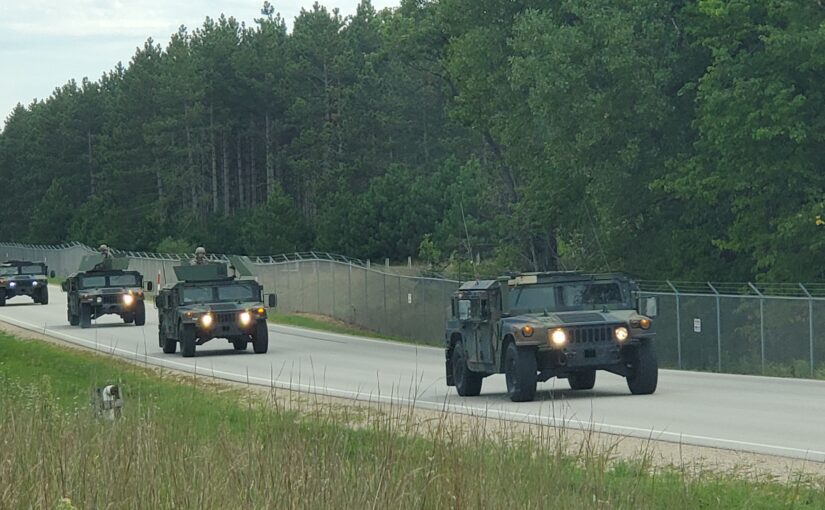
Lieutenant Colonel Aliston glanced in the mirror of the Hummer he was riding in, vaguely concerned that one of his reservists would just wander off as they crossed the border into Nevada.  He’d seen dumber things in his time.

The two weeks at the National Training Center at Fort Irwin California had gone very well.  His soldiers had performed admirably, and he had a deep sense of pride that his team had done their utmost.  For a National Guard unit, training was the rarest commodity of all, and he truly enjoyed getting out into the field, watching his troops do the work they were trained to do.

Being isolated in the remote desert of California also meant he had very little idea of what was going on in the wider world.  He was therefore not expecting any sort of communication from upper echelons.  However, the Hummer he was riding in was basically a big radio with a driver in front and two communications specialists in the back seats.

The specialist (MOS 25S) in the back seat handed Aliston a handset.  “Command for you, sir.”

Surprised, Aliston accepted the handset with a nod.  “Aliston.”

“Ident, Hotel Charlie XRay.”

Aliston had to consult with a card from his pocket for today’s recognition codes.  “Romeo Whisky Sierra.”

“War Plan Ardent Resolve in effect.  Assemble your command at nearest rally point, immediate.  DEFCON 1, medium probability, read back.”

Automatically, Aliston repeated “Assemble at nearest point, DEFCON 1, medium probability.”

“Readback correct.”  The handset in his hand went dead.  Numbly, he handed the handset back to the specialist in the back seat.  There was complete silence in the vehicle except for the loud humming of the offroad tires on the pavement of the interstate.  DEFCON 1 meant that nuclear war was likely or possibly already underway.  Medium probability meant that they didn’t really know yet but were assuming the worst.

Finally, the private driving the Hummer spoke up.  “Sir, is this another training exercise?”

“I’m afraid not, son.  It’s the real deal.”  Aliston picked up a tactical radio.  “Wildhorse Actual to all squads.  Column halt.  Squad leaders, all squads load and make ready.  Weapons Tight, ROE Delta in effect.”

As the column halted on the shoulder of the interstate and semi-trucks roared by, controlled chaos broke out.  While the soldiers had their personal weapons with them, none had been issued ammunition.  Normally, ammunition was only issued at the range or just before going into combat.  Unlike the movies, US soldiers didn’t wander around with loaded weapons on a normal basis.  

After a few minutes, Command Sergeant Major Ziffren walked up to Aliston where he was reviewing his standing orders book.  Aliston knew from the “Ardent” prefix that Ardent Resolve related to an attack on the United States, but he didn’t have all the war plans memorized.  The short version of Ardent Resolve was that all units were to proceed to the nearest rally point and to prepare for a full-on invasion of the USA.  He was still processing his shock when Ziffren saluted.  “Sir, all troops have been issued ammunition.  I have posted front and rear-guard positions and have directed them to mount their M2s.  All vehicle mounted weapons are ready and safed.  Ten more minutes until we are ready to move again.”

“Thank you, Ziffren.  We may be in a pile of shit here.”

“Sir?”

“Northern Command just activated Ardent Resolve.  I had to look it up, but it’s basically full-on invasion of the USA.”

“No shit?”  Ziffren paused, realizing he had just said ‘no shit’ to a senior officer.  “Apologies, sir.”

“None needed, Sergeant.”  Aliston pulled out a map.  “We are still two hours from home.  No idea what the hell we will do in the middle of Las Vegas with just our personal weapons and a handful of ma deuces.”  Like most Reserve units, they didn’t have a full set of M1 tanks just sitting around.  Their equipment was in storage and would take days or even weeks to make ready for combat.

“Sir, if I may, does it say, ‘Return to primary reporting location’ or ‘Report to nearest rally point’?”

“Actually, it’s the latter.”

“So, technically we are closer to Fort Irwin than to home.”  The Sargent pointed to his left.  “If we cut across that ridge, we are right at the back side of the training ground.”

Normally, US Army units moving around the United States stick to paved roads or other approved routes.  Nobody wanted to see Army equipment tearing up the Southern California desert on a regular basis.  Most of the land around this part of southeastern California was protected and vehicles were banned.  For this reason, the regiment had travelled the long way southwest out of Fort Irwin and then turned left onto I-15 towards Las Vegas and home.  However, they were about half as far from Fort Irwin if they went cross-country than if they took the road.  So, technically, Ft. Irwin was their “closest” point.

“I take your point.”

Aliston chose not to discuss the possibility of a nuclear strike.  It really didn’t matter.  Either they made it back to Fort Irwin or they did not.  Focusing on a task like moving his command across country was much simpler than worrying about the world ending.  For good or for bad, he had something he could do.

“Make it happen, Sergeant.”

“Yes sir!”