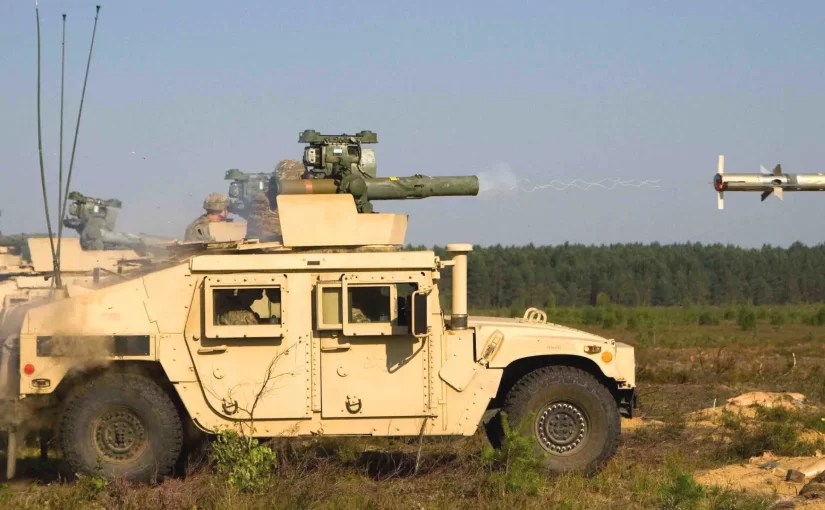
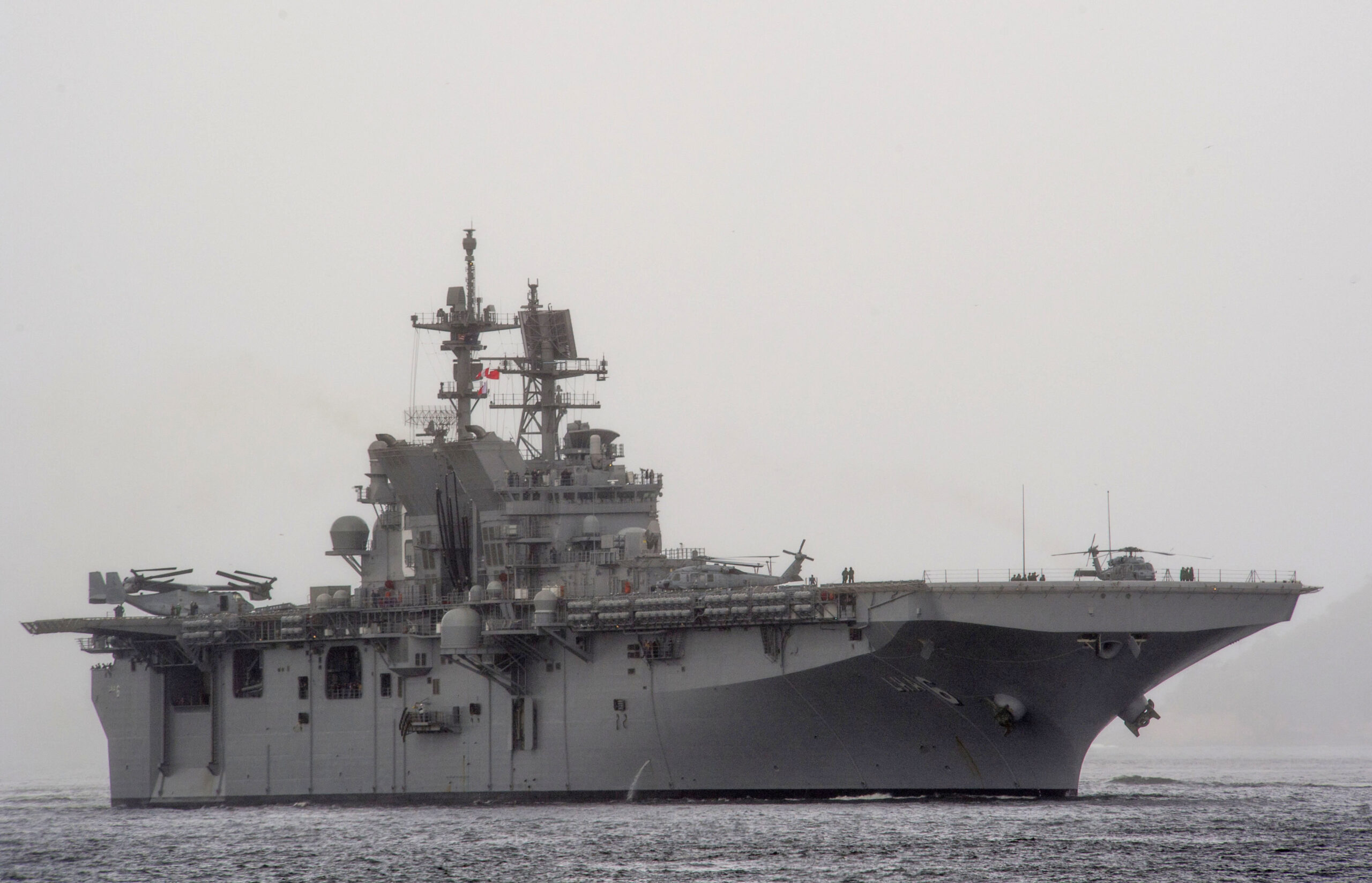
US Navy, Third Fleet , embarked USS Bougainville (LHA-8)
30 NM West Santa Rosa Island, California
“Sir! We have confirmed reports of PLA units moving north on I-5, approximately two klicks south of La Jolla.”
Lensten swore to himself. Again, the Chinese were taking the initiative while the US military stumbled around, unable to get organized due to the ongoing computer and communications outages caused by the Chinese electronic warfare attack on the first day of the war.
“What do we have at Pendleton?” Camp Pendleton was a major US Marine Corps base and straddled I-5 just north of San Diego. The coastal hills came pretty close to the ocean there and it made a natural choke point.
“First Marine got pretty beat up. Plenty of effectives still but a good portion of their equipment was sitting out in the open and got hammered.” Camp Pendleton was home to 42,000 active-duty troops. They had the personnel to defend the Los Angeles basin, but they would need logistics support from the ships offshore.
“Alert the MEU commander. I want them ashore yesterday, prioritize fighting vehicles and ammo until Pendleton digs out. Establish a defensive line someplace close to San Onofre. Dig in deep.”
The liaison Marine raised his hand. “Sir, we train for amphib right there, the beach at the foot of Las Pulgas Road. I’ve taken an AAV ashore there myself.”
Lensten pointed to the Marine. “As the man says. Make it happen.” He turned to his air commander. “Spool up the fighters, I assume we will have company.”
“Yes sir, I have a CAP out now, two birds on plus five and ten more down below. We’ll get them rotating in groups of four to get constant coverage over the beach.”
“Any word from the units ashore?”
“The airfield there took a direct hit. We have recovered a dozen Ospreys and two dozen helos. We had them staged up north at Red Beach.”
Lensten looked at the map. Red Beach airport was a small facility that the USMC used to train crews how to set up Forward Arming and Refueling Points (FARPs). Just a couple of cement strips and a helicopter landing pad. “That’s too far south, let’s move them north and set up a FARP for them there.”
The air commander consulted the map. “HOLF is shut down, but it’s up in the hills up there. Nice and close but sheltered from direct fire.” He pointed to an old air strip up on the hills above San Onofre. It was still within the sprawling Pendleton base, away from civilians. Harder to supply a remote location but easier to secure.
“OK, make the call.”
1st Battalion, 5th Marines
Oceanside, California
Twenty Amphibious Combat Vehicles (ACV) from the 1/5 came tearing down Old Pacific Highway at an absurdly unsafe speed. Suddenly, the lead vehicle screeched to a halt, the others lining up nose-to-tail behind the lead vehicle. Lieutenant Colonel Seville jumped out of the lead vehicle and sprinted to the right where a large culvert poked out of the low hill leading up to the freeway. Sticking his head in, he examined the huge pipe. It was about five feet high. Not comfortable, but his marines could get in there.
“Dismount!” The ACVs disgorged Marines, all in full combat gear and most carrying heavy boxes. “Inside! I want one hundred pounds every five feet. MOVE IT.”
It had taken nearly two days to unearth the ammunition bunkers located deep within the hilly terrain of Camp Pendleton. Whoever had attacked them knew EXACTLY where everything was stored. However, the bunkers had been designed to survive a near miss from a nuclear weapon and were largely intact. The roads, loading docks, and other related infrastructure were not anywhere near as robust. When the team of engineers had finally opened up a room containing twenty tons of C4, Seville knew exactly where to put the bounty. The plan was to blow a huge hole in the freeway to keep Chinese armored units from using it. Unfortunately, this part of I-5 was built along the flat land of the coast and didn’t have any convenient bridges to blow up. This meant doing things the hard way.
Cutting I-5 wasn’t something Seville thought he would ever be doing, but the orders from 1st division command had been explicit. Prevent Chinese armored forces from penetrating the LA basin via the I-5 corridor. The hills in and around Pendleton were tough for armor, and anyone who tried to move THROUGH Pendleton was in for a tough time. Marines were busy setting up tank traps, IEDs, and other forms of ambush in the narrow valleys and arroyos of the base. That left the freeway, the railroad right-of-way or the tiny road he was standing on. Seville was betting on a frontal attack, right up this freeway.
He picked up a handset, “Lima Bravo, One Five Actual.”
“Go for Lima Bravo.”
“Lima Bravo, be advised that the five will be closed for business in three zero mikes.”
“Affirmative, Beachhead Las Pulgas dark in one five mikes. Amphib moves to alternate site San Onofre.”
“Understood.” Seville heard the roar of diesel engines and looked up to see a column of huge LVSR trucks roaring down the empty freeway, each carrying a standard shipping container. The materials in those containers would have to support the Marines defending the narrow strip of land between the hills and Pacific Ocean for at least another day until the teams working feverishly up the hill got the supply situation under control.
Grunting with satisfaction, Sevelle walked back to his antenna-festooned ACV-C command vehicle. “Move us back to the COC.” Unlike the US Army or US Air Force, the USMC was used to operating as independent units. It was normal for a Marine battalion to operate completely independently. With a LHA off the coast like they had at the moment, they also had their own air cover in the form of F-35Bs and Viper AH-1Z helicopter gunships along with an array of logistics support like the V-22 Osprey. The Fifth Marine Regiment had set up a temporary “Combat Operations Center” or COC behind a hill on the other side of the freeway. Marines were also used to operating in austere conditions (as if coastal California could be described as “austere” in any way). As his command AVC-C pulled up to the large tent holding the COC, he exited the vehicle and walked into a swarming hive of activity. Marines in full combat gear were moving in every direction. Moving into the COC, he could hear Colonel Fernandez briefing several other officers.
“Arty, you’re here at Song’s Mesa. I want all four batteries ready for fire missions in thirty.” Fernandez looked at the officer commanding the artillery battalion.
“Aye aye, sir. The units are already moving.”
“How are you fixed for ammo?”
“Could be better, sir. About one hundred M107 rounds for each gun, but no copperheads. I’ve checked with the MEU offshore and they don’t have any either. An even dozen Excaliburs.”
“OK, we’ll save those for anything tasty.” He looked at Seville. “Seville, I want you up on the hill, organize recon and spot for artillery.”
“Aye aye, sir. Explosives will be in place in twenty to close the freeway.”
“Good. You will also have twenty Javelin teams. I want those focused on SEAD. Anything that even looks like anti-air dies first. We need to keep the skies clear for the helos.”
“Roger that, sir. I’m assuming MANPADS.”
“Yes, we’ll just have to take our chances there. Keep moving and hope for the best.”
“Yes, sir.”
“Move it.”
1st Battalion, 5th Marines
San Onofre Mountain, California
Seville carefully inspected the observation post the Marines of 1st Battalion had dug into the top of the mountain. They had taken the time to camouflage it from the air with local plants and to ensure it was fully shielded from infrared by using insulation in the roof. They fully expected to be surveilled by drones and manned aircraft. They were terribly exposed up here on the mountain, but without their normal constellation of supporting aircraft and drones, they needed to have a good observation point with a clear view of the entire battlefield. From up here, they could almost see Oceanside, which was the last town before Camp Pendleton heading north.
A radio tech handed him a handset. “One Five Actual.”
“One Five Actual, Lima Bravo. Confirmed enemy movement, battalion-strength armored column. Ten klicks south of your position, moving north at approximately 20 kph.”
“Copy armored brigade or better ten klicks south. Any update on air?”
“Negative. There are bandits approximately fifty klicks south of the border, unknown intention this time. BARCAP in place, we will attempt to keep them off you, it depends on how heavy they come.”
“Understood. Out.”
At least they had some air support. A Barrier Combat Air Patrol was designed to keep the bad guys away from the battle, but with the limited air power the Marines had at their disposal, nobody really knew if they would be able to keep the enemy fighters away.
In fifteen minutes, they could see the Chinese column. They were moving methodically up the freeway, using light scouting units to close off the onramps and off ramps as they crossed. There was zero civilian traffic, so he wasn’t sure why they were bothering. There had been panic and jammed freeways for two days until martial law had been declared and the freeways closed to civilian traffic. Now that the fighting was about to actually start, it was a relief to see no civilians in the combat zone. As the Chinese crossed into Camp Pendleton proper, Seville raised his tactical radio. “Apache Actual, One Five Actual.”
“Go for Apache.”
“Ready.”
“Affirmative. Call it.”
“Wait.” As he watched, the leading elements reached and passed the CHP inspection station that was just beyond the culvert they had rigged with explosives. The first two tanks were just about to reach the culvert. “Now.”
“Fire in the hole.”
For a painful two seconds, nothing happened. Then a huge section of the freeway disappeared in smoke and dust. Debris flew in every direction. It was nearly two miles between his position and the explosion, and it took nearly eight seconds for the sound to travel that far. The rolling boom was impressively loud even at that distance. Seville held his breath as the smoke and dust cleared, hoping they had used enough explosives. There hadn’t been time to consult with the combat engineers so they had just used as much C4 as they could. After a full two minutes, he knew they had used enough. A deep trench cut across the freeway. No way a tank would get across that.
The Chinese down below knew their business. Within fifteen minutes, bridging units had been called up.
The Marine artillery division had been expecting the call. “Alpha battery copies. Fire mission, high explosive, full spread.”
A few moments passed. “Shot out.”
Seville aimed his binoculars at the target area. He couldn’t hear the rounds, but he could see them exploding. A little short. “Short five zero meters. Adjust and fire for effect.”
The sound of ripping linen pulled his eyes off the target area. “INCOMING! DOWN! DOWN!” He had a moment to curse himself for using the radio too much before the Chinese artillery barrage landed all around his position.
“Alpha Battery, One Five Actual – Fire mission, counter battery.”
“Counter battery aye.”
For the next few minutes Seville just hunkered down in his hole and prayed. He had been under fire before, but nothing like this. An artillery barrage was pretty much the scariest thing he had ever experienced in his fifteen-year career in the Marine Corps. He hoped he would never experience it again, but he was pretty certain that was a false hope. Eventually, the attack slacked off and he was able to take another look at the battlefield. The Chinese were attempting to use bulldozers to open up a route through the trench. He looked around the observation post. Amazingly, none of the three other marines in the small bunker had been injured in the heavy artillery barrage.
“Stalker, One Five Actual.”
“Go for Stalker.”
“I have engineers trying to breech the gap.”
“Roger. Two mikes.”
The ten AH-1Z Viper attack helicopters came streaking in from the Pacific, barely feet above the water, moving as fast as they could to avoid enemy fire. At the last minute, they popped up, fired their hellfire missiles and streaked by, winding their way through the canyons below San Onofre Mountain. SAMs streaked up after them, plucking one Viper from the sky. A Javelin responded, taking out the radar unit supporting the mobile SAM battery. Missiles crisscrossed the sky for several minutes.
Seville grinned as the Chinese armor pulled back, out of the killing zone.
His good cheer didn’t last. “What the hell is that?” It looked like a swarm of insects was coming up the freeway, but insects didn’t move in formation like that. A swarm of black dots moved along, exactly paralleling the freeway. He was still wondering what they were when a group peeled off and headed straight for him. “DRONES! Open fire!”