160th SOAR
Luke Air Force Base, Arizona
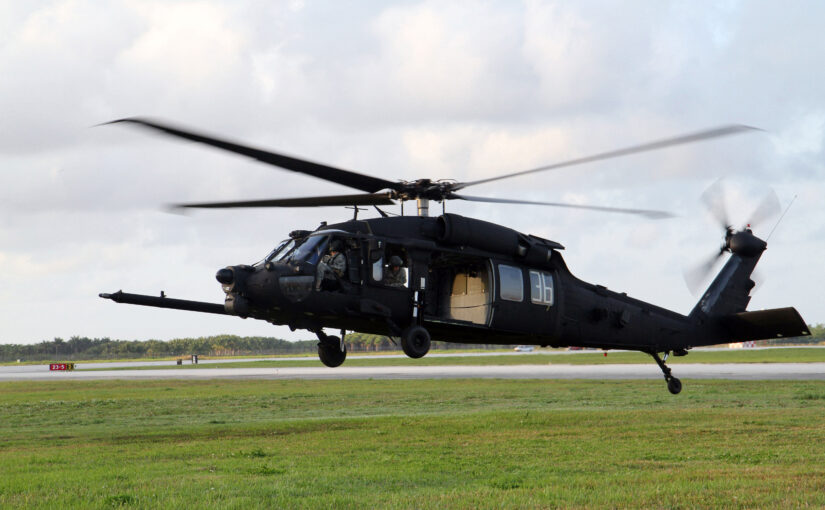
Major Watkins walked around the MH-60M gunship. Specially modified for the Special Operations Aviation Regiment (SOAR), the M variant of the Blackhawk had more powerful engines than a standard Blackhawk and a large refueling probe sticking out the front. The addition of stub wings on each side allowed it to carry missiles and machine guns. At the moment, this bird was equipped with dual M2s and two rocket pods on each wing holding nineteen Hydra 70 rockets. The helicopter wasn’t going to win any fights with a full-on armored platoon, but she’d do well against almost anything less. Finally, he checked the cargo, secured in the main cabin. A full dozen Javelin missiles and other miscellaneous weapons were tightly strapped down inside. Satisfied, he waved to his wingman who gave him a thumbs up.
The mission tonight for the black helicopters was dangerous, but nothing he hadn’t done before. Since the infamous raid on Bin Laden, the 160th had drawn every “impossible” mission that the US military could think up.
While flying a helicopter into Mexico wasn’t normally considered dangerous, the recent events between the USAF and the Mexicans meant that any US military unit had to consider this hostile territory, despite the recent stand-down order from the Pentagon. An order that Watkins and team were about to violate. Doing things that the Army wasn’t supposed to do was pretty much the job description of the SOAR. Going behind enemy lines was a primary mission set for the 160th. The planned mission was right at the maximum range for the MH-60M. This could be extended with external tanks, but that would mean sacrificing weapons load, not something that a SOAR pilot wanted to do. Instead, they would fly southwest and tank up over the Gulf of California from a USMC KC-130J.
Simple enough.
Two hours later, Watkins was swearing at himself for his cocky self-assurance. Weather had closed in, and the storm was making conditions very difficult. Air-to-air refueling in a helicopter was no trivial task at the best of times with the refueling boom projecting out of the front of the helicopter only feet below the spinning main rotor. Approaching the refueling aircraft, he could only vaguely see the formation lights on the propeller-driven KC-130J until he was less than 200 feet from the four-engine turboprop.
The tanker was moving up and down in ten-foot swings, with the refueling drogues flapping along behind. Yeah, piece of cake, Trevor. He signaled his wingman to back off. Normally, they would tank at the same time, one from each wing, but in these conditions, it was safer to just do it one at a time. Approaching slowly, he lined up on the drogue, a small basket hanging off the end of the refueling hose. Slowly, slowly. He was only two feet away when the tanker suddenly rose up, buffeted by an updraft. Watkins pulled up violently on the collective, giving more power to the twin turbine engines and at the same time, he pulled the stick violently back and to the left, causing the helicopter to bank up and to the left. The rising drogue and refueling hose missed the helicopter’s main rotor by no more than a foot. Watkins once again blessed the name of whoever decided that SOAR needed more horsepower in their Blackhawk than “regular” army aviation units.
Collecting himself, he tried again, waiting for the KC-130J’s flight path to smooth a bit before attempting to connect. Finally, he eased the probe into the drogue and fuel began to flow. His copilot let out an audible sigh of relief that caused Watkins to smile. While it took only two minutes to fill the relatively small fuel tanks of the MH-60M, it was an extremely stressful couple of minutes. Finally, his gauges all read full, and he backed off the hose. After getting clear of the tanker, he moved down and to his left to allow his wingman room to maneuver.
The second gunship was having an even worse time of it than his lead. The first approach failed as the tanker started tossing violently in the roiled air. The second attempt didn’t go any better. By the third, Watkins was beginning to become concerned about the safety of the crew and aircraft. Suddenly, the C-130 jerked upward, pulling the drogue dangerously close to the closely following helicopter’s main rotor. With a loud PING the rotor sliced off the hose just below the drogue and fuel began spraying out of the damaged hose. “Stalker two, break, break, break!”
The second helicopter heeled to the left, gaining altitude as the pilot frantically added power. It took a few seconds for the pilot to regain control. After convincing himself that the second pilot was once again in control, he formed up in formation again, flashing his hand light to signal the other helicopter. Despite his earlier radio transmission, they were supposed to be under strict radio silence on this mission. While his brief transmission may have already compromised the mission, he wasn’t going to give any listeners more opportunities to localize him.
He flashed his wingman with a light. “Try again or abort?”
The answer came back instantly, “Try again.”
“Approved, use caution.”
“Affirmative.”
Slowly approaching the other side of the tanker, the second helicopter approached the only remaining refueling drogue. If something happened to this one, they were done. Watkins watched, his heart in his mouth as his wingman made another attempt. Again, the tanker moved violently up, but the pilot was able to adjust and there was no contact. Slowly. Slowly. And in. Finally, the probe was inserted into the drogue. Two full minutes dragged by. Disengaging, the second pilot flashed the all clear.
Turning towards the coast, Watkins punched “Christano”, a tiny town in the Sonoran Desert, into the nav. Going feet dry just south of Puerto Libertad, they reduced altitude to just 500 feet, trusting their AN/APQ-187 terrain-following RADAR to keep them from slamming into a hill.
As they moved inland, the terrain shifted from low rolling hills to taller peaks, their rocky valleys giving the two helicopters excellent cover from the enemy radar that their threat receivers could detect from a hundred miles away when they were flying at 5,000 feet. It was only ninety miles from the coast to their target. Within minutes, he was circling, watching for the IR beacon that the CIA team was supposed to deploy.
There it was.
“Crew, man your weapons.” Just because the IR beacon had the correct settings didn’t mean it was safe down there. Coming in low, he could see several HMMWVs around the perimeter and two SUVs parked next to a fuel truck. A clearing had two beacons sitting roughly in the center, about the right distance apart for the two Blackhawks. These folks have run an LZ before. Nice to know he was working with professionals, not a given in his line of work.
Carefully, the two gunships set down. Landing a helicopter at night without proper lighting isn’t the easiest thing in the world, but the winds were light which made things safer if not exactly easy. The door gunners kept their weapons trained out and ready. Watkins kept the rotors turning, watching for the agreed signal.
A woman dressed in desert camo fatigues stepped forward, flashed a hand light to the lead helicopter. Three, two, four. Watkins answered, one five, two. With that, he began to shut down his engines, noticing that his wingman did the same.
The ground crew quickly moved in to begin refueling operations. The equipment was from a civilian airport but as long as it was Jet-A or similar, the helicopters would be fine. Watkins completed his checklist and climbed out of the helicopter to be met by the woman in desert camo along with a man wearing black body armor with the word “MARINAS” on it and two other men in civilian clothes—one looked Korean and the other screamed “ARMY” for some reason. Army spoke first.
“Major, welcome to Sonora. I am Captain Peters, this is Park from CIA, Commander Bustamante from the Mexican Marine Corps and Captain Harris, US Navy.”
After shaking hands all around, Watkins shook his head with a smile. “Interesting crew you have here, Captain.”
“You don’t know the half of it, sir. When do you need to head up north?”
“Well, our mission plan called for us to be on station for just a few hours, then back out to the gulf to refuel, but the conditions out there are pretty bad. I’m not sure that mission plan is viable. Is it possible for us to find or construct some shelters for the birds during the day?”
The Mexican chuckled. “We may be able to help you there, major.”
Peters looked at Bustamante inquiringly. “What do you have in mind, Commander?”
“Do you not realize where we are, Capitan?”
“No, one part of desert looks the same as another to me.”
“This is the same spot as the FARP we used the night the two of us met.” He turned and pointed over his shoulder. “Our mission objective for that night is on the other side of that hill there.”
Peters laughed and Ping Pong looked confused. “We found two Russian helicopters there.” Ping Pong shrugged. “Inside hangers. With landing pads.” He turned back to Bustamante. “Has that house been reoccupied?”
“No, Capitan. I left a squad there to secure it. I have been in contact since; nobody has ventured near.”
“That’s hilarious. Let’s do it.”
Within an hour, they had flown the helicopters to the Italianesque mansion and secured them inside the two hangers which had remained amazingly undamaged despite the firefight just outside weeks before. Peters counted an even dozen bullet holes in the metal walls, but nothing that prevented their use.
“Let’s get these other vehicles out of sight. Only the guard team can be seen during the day.”