Book 2: Episode 30

221st Cavalry Regiment (Nevada National Guard)

I-15, San Bernardino County, California, USA

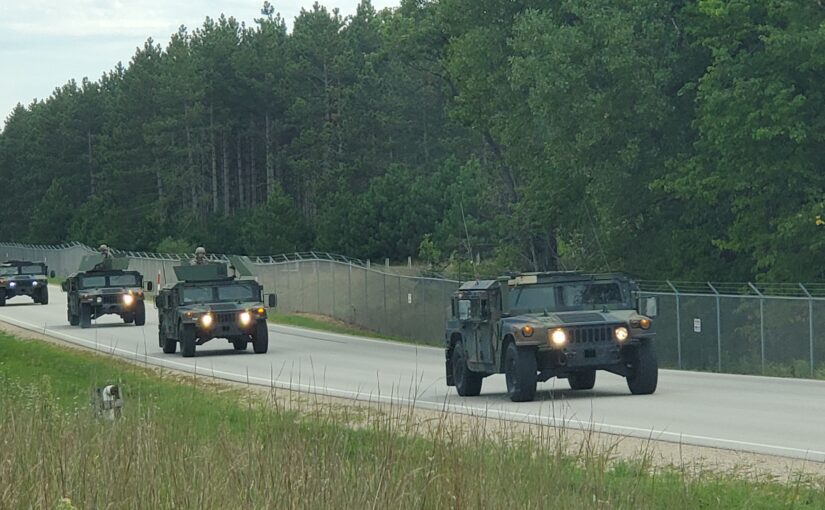
Lieutenant Colonel Aliston glanced in the mirror of the Hummer he was riding in, vaguely concerned that one of his reservists would just wander off as they crossed the border into Nevada.  He’d seen dumber things in his time.

The two weeks at the National Training Center at Fort Irwin California had gone very well.  His soldiers had performed admirably, and he had a deep sense of pride that his team had done their utmost.  For a National Guard unit, training was the rarest commodity of all, and he truly enjoyed getting out into the field, watching his troops do the work they were trained to do.

Being isolated in the remote desert of California also meant he had very little idea of what was going on in the wider world.  He was therefore not expecting any sort of communication from upper echelons.  However, the Hummer he was riding in was basically a big radio with a driver in front and two communications specialists in the back seats.

The specialist (MOS 25S) in the back seat handed Aliston a handset.  “Command for you, sir.”

Surprised, Aliston accepted the handset with a nod.  “Aliston.”

“Ident, Hotel Charlie XRay.”

Aliston had to consult with a card from his pocket for today’s recognition codes.  “Romeo Whisky Sierra.”

“War Plan Ardent Resolve in effect.  Assemble your command at nearest rally point, immediate.  DEFCON 1, medium probability, read back.”

Automatically, Aliston repeated “Assemble at nearest point, DEFCON 1, medium probability.”

“Readback correct.”  The handset in his hand went dead.  Numbly, he handed the handset back to the specialist in the back seat.  There was complete silence in the vehicle except for the loud humming of the offroad tires on the pavement of the interstate.  DEFCON 1 meant that nuclear war was likely or possibly already underway.  Medium probability meant that they didn’t really know yet but were assuming the worst.

Finally, the private driving the Hummer spoke up.  “Sir, is this another training exercise?”

“I’m afraid not, son.  It’s the real deal.”  Aliston picked up a tactical radio.  “Wildhorse Actual to all squads.  Column halt.  Squad leaders, all squads load and make ready.  Weapons Tight, ROE Delta in effect.”

As the column halted on the shoulder of the interstate and semi-trucks roared by, controlled chaos broke out.  While the soldiers had their personal weapons with them, none had been issued ammunition.  Normally, ammunition was only issued at the range or just before going into combat.  Unlike the movies, US soldiers didn’t wander around with loaded weapons on a normal basis.  

After a few minutes, Command Sergeant Major Ziffren walked up to Aliston where he was reviewing his standing orders book.  Aliston knew from the “Ardent” prefix that Ardent Resolve related to an attack on the United States, but he didn’t have all the war plans memorized.  The short version of Ardent Resolve was that all units were to proceed to the nearest rally point and to prepare for a full-on invasion of the USA.  He was still processing his shock when Ziffren saluted.  “Sir, all troops have been issued ammunition.  I have posted front and rear-guard positions and have directed them to mount their M2s.  All vehicle mounted weapons are ready and safed.  Ten more minutes until we are ready to move again.”

“Thank you, Ziffren.  We may be in a pile of shit here.”

“Sir?”

“Northern Command just activated Ardent Resolve.  I had to look it up, but it’s basically full-on invasion of the USA.”

“No shit?”  Ziffren paused, realizing he had just said ‘no shit’ to a senior officer.  “Apologies, sir.”

“None needed, Sergeant.”  Aliston pulled out a map.  “We are still two hours from home.  No idea what the hell we will do in the middle of Las Vegas with just our personal weapons and a handful of ma deuces.”  Like most Reserve units, they didn’t have a full set of M1 tanks just sitting around.  Their equipment was in storage and would take days or even weeks to make ready for combat.

“Sir, if I may, does it say, ‘Return to primary reporting location’ or ‘Report to nearest rally point’?”

“Actually, it’s the latter.”

“So, technically we are closer to Fort Irwin than to home.”  The Sargent pointed to his left.  “If we cut across that ridge, we are right at the back side of the training ground.”

Normally, US Army units moving around the United States stick to paved roads or other approved routes.  Nobody wanted to see Army equipment tearing up the Southern California desert on a regular basis.  Most of the land around this part of southeastern California was protected and vehicles were banned.  For this reason, the regiment had travelled the long way southwest out of Fort Irwin and then turned left onto I-15 towards Las Vegas and home.  However, they were about half as far from Fort Irwin if they went cross-country than if they took the road.  So, technically, Ft. Irwin was their “closest” point.

“I take your point.”

Aliston chose not to discuss the possibility of a nuclear strike.  It really didn’t matter.  Either they made it back to Fort Irwin or they did not.  Focusing on a task like moving his command across country was much simpler than worrying about the world ending.  For good or for bad, he had something he could do.

“Make it happen, Sergeant.”

“Yes sir!”
Book 2: Episode 29

United States Northern Command

Cheyenne Mountain Space Force Station, CO

“Sir, we have a problem here.”

General Wilkes stood up and walked over to the chief master sergeant who was running ops for Cheyenne mountain.  “What is it, Sergeant?”

“One of those new Chinese birds has separated into a hundred pieces.  Radar is tracking a cloud surrounding where it used to be.”

“Meteor strike?”

“Perhaps…”  He clicked a few buttons and the main display shifted, showing a computer image processed from the massive PAVE PAWS radar installations used to track satellites and missiles in orbit.  “SIR!  They are maneuvering!”  That only meant one thing.  The satellite had deployed multiple objects that each had their own maneuvering controls.  The satellites hadn’t exploded; they had launched hundreds of weapons.

“DROP KICK.”

“Yes, sir!  I have a definite DROP KICK.  Confirming.”

DROP KICK was the US military code word for space-based weapons release.  Even though this was specifically illegal under the Outer Space Treaty, it was a situation that the USAF had planned for and trained against for over fifty years. 

“Issue a FLASH warning to all commands.  The CONUS is under attack from space-based weapons systems, DROP KICK high confidence.  Possible nuclear attack under way.  Raise alert status to DEFCON 1.”

“Yes, sir.”  Alarms started blaring all over the complex, deeply buried under Cheyenne mountain.  A relic of the cold war, the facility was partially shut down, with only a skeleton crew normally on duty.  Despite the stand-down order from the Pentagon, Northern Command had decided to maintain a standby watch out of prudence.  Wilkes could hear the alarms ringing as the massive vault door closed, sealing the facility off from the outside world.  “Sir, additional separations across multiple satellites.  We have at least twenty events; tracking over four hundred inbounds.  Tracks are firming up, confirming targeted on CONUS.  Impact in twenty mikes.  Nuclear threat-level medium confidence.”

Twenty minutes to try and defend the USA against a nuclear attack?  The threat assessment of “medium” meant that the US military really didn’t know if the incoming weapons were nuclear or not, but presumably the president would have to assume they were.  The ballistic missile defense system deployed in Alaska was in the wrong place—it was designed to intercept ICBMs coming over the pole from Russia, not an attack from satellites orbiting over the continental USA.  During the cold war, the US military’s strategic weapons were at a very high state of alert.  At one point, B-52s were in the air 24/7, ready for just such an attack.  Today, the ICBMs buried in their silos in the Midwest and the SLBMs of the Navy were on “standby” but their ability to strike targets in China was unknown.

“General, the video call with the president is starting.”

Standard practice in the case of a suspected nuclear attack or almost any serious emergency threatening the USA, a video call was established between the president and the military leadership including the secretary of defense and the chairman of the Joint Chiefs.  Even though Wilkes was a general, he wasn’t at the exalted level to participate in a call like that.  What he did get was a summary of the call and orders handed down.  He also was privy to orders given to other commands, such as STRATCOM, the overall command responsible for nuclear weapons within the US military.

FROM:  POTUS

TO: USSTRATCOM

NUCLEAR WEAPONS RELEASE IS HEREBY AUTHORIZED AS PER WAR PLAN SIGMA.  COMMENCE STRATEGIC NUCLEAR ENGAGEMENT AGAINST PLANNED TARGETS AS PER SIGMA.  WEAPONS POSITIVE RELEASE VIA NC3.

NCA ENDS

Wilkes dropped down into his chair.  He never expected to be involved in WWIII, let alone be sitting in one of the few places in the USA designed to survive a nuclear attack.

Get yourself together mister, nuclear attack or not, there is a job to do.  Wilkes reached out and punched the button to start a video call with his boss, the commander of Northern Command.  “Sir, are you going to move your command here?”

“Negative, Wilkes, no time.”  He turned to speak to someone just off camera.  “DOUBLE CHECK THAT.”  He turned back to Wilkes.  “We are losing SATCOMs again.  Looks like a coordinated attack.  I am going to execute Ardent Resolve now.  Good luck, Barry.”

“Thank you, sir.”

Ardent Resolve was one of the plans maintained in case of an attack on the United States.  It assumed a surprise attack like this one and called for military units to muster to designated points and prepare for an invasion.  At this point, they really didn’t know anything beyond the ongoing space-based attack, but it made sense to assume that there would be some sort of follow on.

Hanging up the connection with his boss, Wilkes had a moment of sheer terror.  What was about to happen was not something anyone could face calmly.  After a few seconds, his brain clicked in, tamping down emotion, focusing on the tasks at hand.   His time as a fighter pilot over the Pacific had shown him that he could work through the fear.  It was still there, just compartmentalized into a back corner of his brain.  He would pay for this later, but for now, he could still function, which was all that mattered.