U.S. Army Tank-Automotive and Armaments Command (TACOM)
Amedee Army Airfield, Herlong, California
The C-17 came to a stop, exactly on its mark, and the rear ramp started to deploy even before the engines had completely wound down. A Marine corps colonel was the first Marine off the plane. Looking up the ramp, he could see about a hundred more Marines, fully kitted out in desert camouflage uniforms, waiting to debark. Kumar walked over to the colonel and extended a hand. “Welcome to Sierra Army Depot, Colonel.”
“Fawkes. Glad to meet you. Have you been briefed?” The tall Marine officer waved a hand at a gunnery sergeant hovering at the foot of the ramp who immediately started the process of debarkation.
“Yes, NORCOM actual called me personally.”
Colonel Fawkes stopped for a moment, surprised, then shook his head. “I guess I shouldn’t be surprised. I got a call at six AM from the commandant of the Marine Corps.”
Kumar smiled. “Not every day you get a call from him?”
Fawkes laughed. “No. First time for me.”
“Same.”
“So, can you do it?”
“What, get one hundred and fifty tanks ready to go in just two days?”
“Yes, that minor matter.”
“You forget where you are, Fawkes.” With a broad expansive gesture at the desert all around him, he smiled. “This is what we do. It’s all we do.” He gestured to the Humvee waiting a few yards away. “Would you care to inspect your new command, Colonel?”
As the Humvee left the airport and turned left onto Magazine Road, Kumar asked the question that had been driving him crazy since his orders had arrived. “I thought that the Marines didn’t have any tankers left? Where did you all come from?”
Fawks laughed. “You don’t work with Marines much, do you?” Kumar just shook his head. “We don’t worry about what your MOS is or anything like that. All Marines are riflemen first, everything else is secondary. We’re taught that in basic. Even pilots should be able to pick up a gun and defend themselves if needed. In this case, the commandant called II MEF and asked for volunteers who had previously served in tanks.” II Marine Expeditionary Force (II MEF) was the largest Marine Corps command on the East Coast.
“And I assume you got enough volunteers?”
Fawks laughed again. “I only took about twelve hundred. I had at least three thousand volunteer. There are some pissed off Marines out at Lejeune who didn’t get the call up.” He gestured vaguely east. “There are eleven more C-17s coming in with the rest of the Marines.”
“What about maintainers? Mechanics? Logistics train?”
“That, not so much. We will pick up what we can at Twentynine Palms.”
Kumar shook his head. “My orders are explicit. You are to be provided with my full support. There is no way you are leaving here without a full logistics train.”
“I’m not?”
“No, you’re not.”
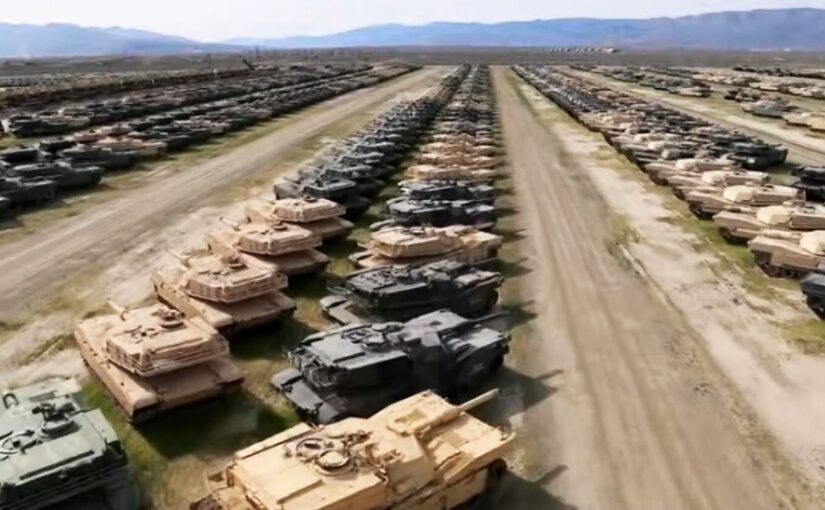
As they pulled onto the main post at SAID, the driver turned left, past a massive storage yard and entered another gated, fenced area. The fence was topped with barbed wire and armed US Army soldiers stood guard at the gate, backed up by two armored JLTVs. After showing their IDs the vehicle was allowed inside. Fawks had assumed that there would just be a row of tanks in the yard, hopefully fueled. What he saw instead stunned him. There were over two hundred Heavy Equipment Transporter System (HETS) trucks lined up in neat rows. Each one loaded with either an M1 tank or various bits of supporting equipment from basic shipping containers to fully kitted out M88A2 HERCULES tank recovery vehicles. “Jesus Christ.”
Kumar patted Fawkes on the shoulder. “Compliments of US Northern Command.”
Task Force Anvil
US-395, Lee Vining, CA
Over two hundred military transports moving along US-395 made an impressive sight. Spread out over two miles, the convoy also included two dozen JLTVs for security traffic duty. The JLTVs sped ahead of the large transports, blocking side roads and other highway entrances to ensure that the convoy could make a steady fifty miles an hour. Two dozen tankers had been sent ahead to provide fuel for the trucks. Fawkes would never admit it, but working with the Army certainly had its perks. As a Marine officer, he was used to making do with less. They normally had the full support of the US Navy, but the Marines were the “junior service” in that relationship, often flying cast off Navy jets and getting second choice when it came to weapons systems and other support. The US Army on the other hand was a logistics machine as he had just experienced.
As the transports parked at the FARP, refueling trucks moved from transporter to transporter. At the same time, tank crews released the chains holding down the turrets and fired up their M1s for the first time. Despite his bravado to Colonel Kumar, Fawkes was a little concerned about his ability to carry out operation “Doolittle.” He hadn’t even been aboard a tank in almost two years and these tanks were the relatively modern M1A2 SEPv3 version. The Sierra Depot had taken charge of these refreshed tanks because part of their mission was to deploy material to deployed units. If an Army unit in the Pacific theater suddenly needed ten replacement tanks, it was the Sierra Depot that would put them on a C5 or a ship so that the unit could get back up to full combat effectiveness as soon as possible.
The upgraded tanks were both good news and bad news for the Marines. The good news was that the SEPv3 upgrade had included the trophy self-protection system which would literally be a life saver in combat. The bad news was that none of his crew had ever operated a SEPv3 Abrams before. They had literally been handed refresher courseware as they boarded their planes. All they knew was what was in the training manuals they had each read. For this reason, the decision had been made that each tank crew would spend as much time as possible inside their new rides, even taking advantage of refueling stops like this one.
Getting into his own tank, Fawkes was once again impressed with the new displays and enhanced optics. The SEPv3 was better in every way than his old M1. He started trying out systems that he had read about but hadn’t actually used. The basics were familiar, the M1 was still the same basic machine as before, just with updated controls and some enhanced functionality. He started flipping switches, activating all the major systems. The new consoles were amazing. Full color displays showing things like friendly units, known enemy positions, tons of information. He zoomed out the map to show all of California. All known friendly positions were clearly identified. He could see Army units engaged on I-10. Wait.
“This thing is showing live data!”
“What was that, sir?” The sergeant who led the refueling crew popped his head into the open hatch.
“We have full link 16 with every unit in California! Hell, I can see the entire West. Navy also!”
“How the hell can we do that?”
“No idea.”
“SIR!” Another head appeared. “When I was in country we got BACN support, and the Army boys showed me their tactical. We got all kinds of shit from all over.”
“That must be it.” He started really looking closely at the display. It looked like the troops down south were in big trouble. According to the system, enemy strength was about double what the defenders had. Of course, these were just estimates. If anything, it was safe to assume that these estimates underrepresented enemy strength since they only reported units that had been actually observed by friendly forces. His brief had said that ISR (Intelligence, Surveillance, and Reconnaissance) was very thin on the ground so they could be missing huge numbers of enemy assets scattered around Southern California and northern Mexico.
He continued to investigate the display, but suddenly, the icon indicating data link quality went red. The system remembered everything it had seen, but new updates weren’t coming in any longer. However, the system had been up long enough for him to see a couple of vital details. One was that there was an overall theater commander. That hadn’t been true when he got on the plane at Marine Corps Air Station (MCAS) New River the day before. He assumed that the brief sync also showed his position to theater command. Without operative satellite communications, he had no way of communicating to “Bravo Uniform” which was the radio code name for the USS Bougainville. He sincerely hoped that SACWEST was paying attention.