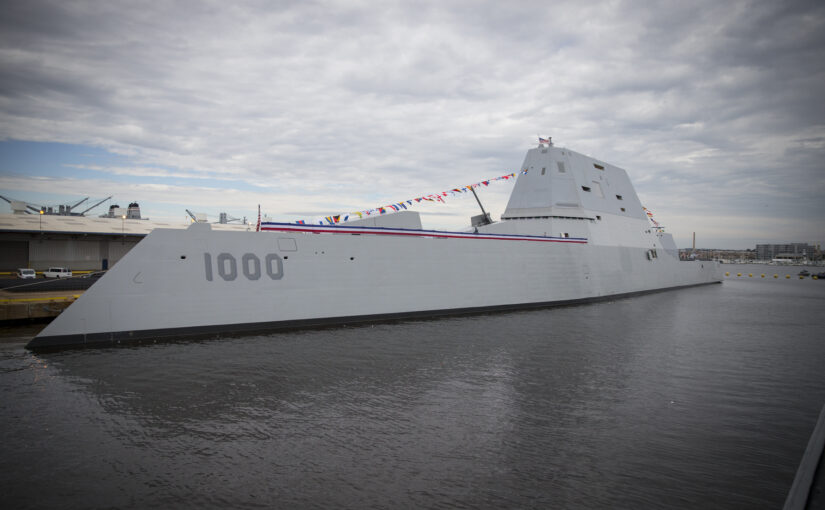
Naval Surface Force US Western Command (SURFWEST), embarked USS Zumwalt (DDG 1000)
250 Miles Southwest, Cabo San Lucas, Mexico
“COMSURFWEST to all Rapier Units. Execute OPORD Rapier, H-Hour 0600 ZULU. Maintain EMCON, ROE Alpha in effect.” Admiral Harris put the secure handset down. Operation Rapier was about to commence. The largest US Navy Surface action since Operation Praying Mantis in 1988.
Newly armed with the Army developed Conventional Prompt Strike hypersonic missile, the Zumwalt was the only ship in the entire US Navy currently so equipped. Despite the fact that the system was not officially operational yet, the decision had been taken to have the Zumwalt lead the attack on Manzanillo. Intelligence was much sparser than Harris would like but several days of submarine based surveillance had confirmed dozens of Chinese flagged cargo ships heading towards the port there. This made sense since Manzanillo was the largest port on Mexico’s west coast and it was supported by rail lines north towards the United States. The intelligence estimate was that 80-90% of the equipment and supplies needed by the Chinese to support the invasion were coming right through this port.
Harris turned back to the plotting table, examining the positions of his ships carefully. They had managed to recall the USS Michigan (SSGN-727) which would increase their striking power immensely. However, they didn’t have the air support that they would normally use as a follow on. This explained why the USS Santa Barbara (LCS-32) was sailing all by herself just one hundred miles off the Mexican coast.
Harris was concerned. He remembered the fate of the Shiloh during the SCS War. That Ticonderoga class cruiser had been sunk and only 40 of her sailors had survived. Now he was asking the much smaller LCS class Santa Barbara to essentially play a similar forward role. The situation here was very different, but that didn’t stop images of wounded sailors being pulled out of the sea from going through his head.
“Admiral, we have a problem, PLAN submarine, bearing One Oh Eight. Range ten miles.”
Strangely, the Zumwalt, a ship designed for shore bombardment, had one of the best anti-submarine capabilities of the entire USN surface fleet. With a bow mounted sonar, towed array and a nixie, she was every bit as capable as any other surface combatant and had a much larger flight deck to carry the critical anti-submarine helicopters needed to defend a surface fleet. Unless, of course they had friends. “Fire up deep siren, give the Seawolf the go.”
Unlike the last war, the US Navy had finally cracked the technical challenge of sending real time communications to submarines while underway. Since WWII, submarines had relied on regular radio to communicate. That meant either coming to periscope depth to communicate with VHF and satellites or using Extremely Long Frequency (ELF) radios that were very bandwidth limited. So much so, that only a few characters could be sent every minute. The new Deep Siren system used a buoy to receive radio messages and then re-transmitted the encoded message via audio signals which the submarine could pick up on their sonar system. This would be the very first operational use of the system.
USS Seawolf (SSN-21)
Middle America Trench, Depth 1,000 Feet, 50 miles southwest Manzanillo Mexico
Commander Higgensbush frowned over the message that the Deep Siren Tactical Paging (DSTP) operator handed him. The Seawolf was an odd boat, only one of two boats in her class constructed (not including the Carter which was significantly different than her other two sisters of the class). Designed to take down anything the Soviets could build during the cold war, the end of the Soviet Union had meant she had no mission. Like the B-2 bomber, the program was abruptly cancelled as part of the larger “peace dividend.” This made her a VERY expensive carrier escort with essentially no mission to perform during the entire Global War on Terror (GWOT). While the replacement boat, the Virginia class was a good boat, they were generalists. Designed for a variety of missions including global strike. Not the Seawolf. The Seawolf was a hunter. No purpose other than killing other ships and specifically designed to kill submarines.
During the SCS war, Seawolf and her sister ship the Connecticut had been stationed in New London Connecticut, a holdover from the cold war when she was expected to fight the Soviets in the North Atlantic. The SCS war had made that plan obviously out of date and both the Seawolf and the Connecticut had been homeported in Kitsap along with the bulk of the Pacific Submarine Force. Unfortunately for the USN, Connecticut had impacted a seamount (basically an underwater mountain) and was currently in dry dock in Bremerton.
Since receiving her orders as part of the larger operation Rapier, Seawolf had been skulking along the Middle America Trench which ran along the coast of Mexico down to Central America, reporting on the large amount of Chinese shipping traffic in and out of Manzanillo. Although the Seawolf had a much deeper test depth than other American attack submarines, she could not get anywhere close to the bottom of the trench which reached over 20,000 feet deep in places. It was the perfect operating area for Seawolf. The deeper she went, the denser the water. This density made her quieter and allowed her sonar performance to improve. Although all USN submarines were quiet, the Seawolf was the pinnacle of US submarine technology. The Seawolf was quieter at 10 knots than a Los Angeles class was sitting at the dock. The difference in sound was astounding.
All of this meant that the Seawolf was as silent as on open grave as she stalked her prey, five miles away.
“Sonar, Con. Report all contacts.”
“Conn, sonar. I have Sierra 1, bearing three five zero, speed five knots. Confirmed submerged, likely Yuan class, definitely AIP. Master contact two evaluated to be US LCS Class, confirmed jet pump propulsion. Bearing three five five, surface contact, speed thirty five knots. Master two is turning. New course two seven zero.” Air Independent Propulsion (AIP) had been a revolution in non-nuclear submarine design. They were able to move very quietly, in some cases even more quietly than a nuclear boat.
“Weapons, evaluation?”
“Sir, confirming the intel from ComSurfWest. We have a PLAN Yuan class going after that LCS. According to the intel report, she is the Santa Barbara.”
Higgensbush tapped the chart. “Those LCS tin cans can move when they want to.”
“Yes, sir, but not enough to escape, the submarine will have her in less than thirty minutes. Those AIP boats aren’t fast but they’re quiet as hell. No idea how the Zumwalt heard her.”
“We did a fleet ex against her last year, good sonar crew there.”
“Apparently.”
“Fire control, set up a solution for Seirra 1. I want one fish on her and another ready to go. Low speed at first, then increase to maximum if the shot is detected.”
“Aye, aye. Targeting primary shot with tube one, backup shot with tube two. Solution locked.”
“Captain has the conn.”
“Aye, captain has the conn.”
“Take her up two hundred.”
“Diving control, make your depth eight zero zero, up ten on the fairwater planes.”
“Making my depth eight zero zero, up ten.”
The Seawolf groaned slightly as the pressure on the hull reduced. It was a risk changing depth, but taking torpedo shots at extreme depths used up too much of the boat’s reserve air supply. Even two hundred feet higher reduced the amount of air required by a significant degree.
“Sir, my depth is eight zero zero.”
“Weapons free.”
“Sir, my weapon is hot, ready to shoot.”
“Shoot.”
“One away. Good track.” The MK48 ADCAP Mod 7 torpedo moved at a relatively sedated twenty knots away from the American attack submarine, attempting to reduce its noise signature and get closer before detection.
“Conn, sonar, cavitation from Sierra 1, he heard that.” The weapons technician issued an order over the command wire linking the torpedo to the submarine and it exploded into motion. Officially listed as “greater than 28 knots” the actual top speed of the MK48 was over 55 knots due to its advanced axial-flow pump-jet, essentially a jet engine under water. While the AIP system in the PLAN submarine was quiet, it wasn’t as fast as a nuclear boat. Even the Seawolf, one of the fastest boats in the US inventory, would have trouble outrunning a MK48. The PLAN boat had no chance.
“Hit! That’s a hit! Air escaping, screws are going to maximum, they’re trying to surface the boat. Hull breach. We are getting breakup noises. Boat is going down. Target is down hard. Passing crush depth.”
The USS Seawolf had just achieved the second fully submerged victory over another submarine and the first by a nuclear submarine ever.
USS Santa Barbara (LCS 32)
40 miles northwest, Manzanillo, Mexico
“Launch!”
With that command, the sailors on the Santa Barbara’s flight deck fired the solid rocket boosters attached to the six LUCAS drones arrayed there. The rockets fired for a few seconds to get the small triangle shaped LUCAS drones airborne, then the small engines on the drones took over and propelled the drones up to their maximum cruising speed of about one hundred miles per hour. Fast for a car or a boat, but slow as hell for an aircraft. The only good thing about LUCAS was that it was cheap. You could loft them from almost anywhere (even the deck of a small ship like the Santa Barbara) and they were cheap enough that you didn’t worry about getting them back.
Captain Guererro trotted back to the CIC. “Flank Speed! Get us the hell out of here. Set course two seven zero.” Guererro knew that the Santa Barbara had no business being this close to a major enemy base like Manzanillo. However, their air assets were so limited that he had volunteered to scoot in and fire off his drones. He hoped that the speed of his “little crappy ship” would get them out of trouble. “Captain, radar contact. Designate target Romeo six. Heading one seven five at two hundred knots, altitude five hundred feet.” A Chinese aircraft flying that low and slow meant it was probably a maritime patrol aircraft. Perhaps a specialized sub hunter.
“BLOODHOUND! BLOODHOUND! BLOODHOUND! Torpedo bearing one seven five. Speed fifty five knots!” There was a pause as the sonar operator examined her scope. “It’s a Mark 48, ADCAP. Confirmed, submarined launched torpedo. Cavitation!! There is a PLAN submarine down there. It’s attempting to get away. Not going to make it! HIT! That’s a hit!”
Guerrerro turned to his Tactical Action Officer (TAO). “That Chinese bird surely heard that. Are we close enough to take a shot at her?”
“Not unless we turn.”
“Helm, new course, zero nine zero. Maintain flank speed.”
“TAO, set it up, let’s make sure our friend down there is safe.”
“Aye, sir. Weapons free, anti-air. Set condition zulu throughout the ship. All hands, man battle stations, air defense. I say again, set condition zulu.”
The Santa Barbara was ridiculously underprepared to fight an air action. Designed for lower intensity warfare, she wasn’t equipped with Aegis or a proper Vertical Launch System (VLS) like her larger sisters. She did carry Hellfire missiles which were originally designed to attack tanks from the air. The latest Longbow version of the Hellfire was radar guided and had a limited surface to air capability, mostly meant to attack drones. However, the Chinese aircraft was slow enough that they might be able to hit it.
Flying low over the ocean, the Chinese Shaanxi KQ-200 was too intently focused on the American submarine that had attacked their comrades on the PLAN submarine to pay enough attention to the Santa Barbara. They had detected the LCS over thirty minutes ago, but had largely ignored the small ship, focusing instead on the threat of submarines. They had reported the contact and had been told that the PLAN submarine five miles away would take care of the US ship. Besides, the small torpedoes mounted in the belly of the aircraft were not designed to attack surface ships, only submarines.
Guererro didn’t know or care why the Chinese aircraft wasn’t making avoiding maneuvers. He just knew that the aircraft was coming into his very limited range. Suddenly the small ship shuddered with the launch of a Hellfire, then another. The ship’s radar queued the missiles onto the aircraft but then the small radar seekers on the missiles took over. A far cry from the speedy missiles carried by a Burke class destroyer, they were more than enough for the lumbering low level turbo prop.
“Hit! That’s a hit! Splash one!”
“Helm, new course two seven zero.”
“Two seven zero, aye.”
Now they had to pray. They were very exposed, almost one hundred miles from the main body. An easy shot for any Chinese anti-ship missile crew.
LUCAS mentioned, fantastic