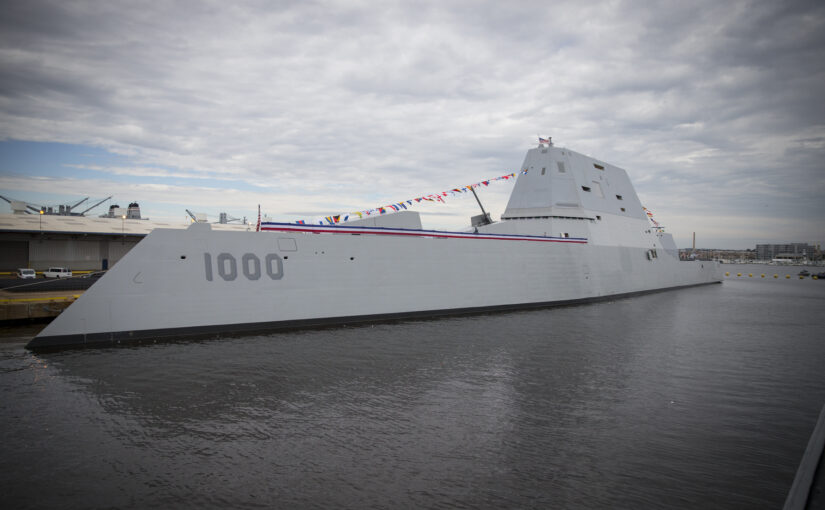
Naval Surface Force US Western Command (SURFWEST), embarked USS Zumwalt (DDG 1000)
250 Miles Southwest, Cabo San Lucas, Mexico
“We are getting overhead.”
The lack of either satellite or aircraft-based surveillance had turned American tactics on their head. US commanders had become accustomed to extremely detailed overhead imagery available to them day or night. The satellite constellation operated by the National Reconnaissance Office (NRO) was so sensitive, it could detect a missile launch anywhere on earth. For the navy, this normally meant that they knew well in advance when being attacked by anti-ship missiles. During the South China Sea (SCS) conflict, the US Navy always had significant warning prior to missile attacks. It also meant that they had high quality targeting information. During the SCS war, the US Navy had successfully engaged targets on the islands in the SCS and on the Chinese mainland.
Until satellite communications were restored, that capability wasn’t available to the Americans. Without any carriers in this part of the Pacific, they also had limited air support. All of this meant that operation Rapier was counting on relatively low-cost drones for targeting information. Only five of the six launched by the Santa Barbara were reporting in. The other one either malfunctioned or got shot down.
Admiral Harris hunched down and examined the imagery over the shoulder of the Intelligence Specialist rating examining the take from the drones. He leaned over and pointed. “There.”
“Yes, sir.” They knew that the PLAN was operating their top of the line HQ-9 SAM system at Manzanillo and they had already lost two aircraft trying to surveil the port. Plan Rapier called for attacking the supporting HT-233 phased array radar systems. The HT-233 was truck mounted and could be moved fairly easily which meant they needed live intelligence before they could target them. The HT-233 wasn’t small. It was a gigantic flat plate, similar to the phase array radars on US destroyers and cruisers. They knew that there were three of them operating in the Manzanillo area from their emissions, but they needed to know EXACTLY where they were before Rapier could proceed.
Harris turned to the Zumwalt’s Commanding Officer, Captain Sanchez. “Captain, you may proceed with Rapier.”
Sanchez nodded. “Yes, sir.” He turned to his Tactical Action Officer (TAO). “TAO, weapons free, land attack.”
The TAO walked back to his station. “We are green across the board, within the launch basket, ROE satisfied.” He picked up a microphone and spoke over the 1MC. “Strike. Strike. Strike. Weapons, stand by for Prompt Strike launch.”
The rating manning the weapons console answered almost immediately. “Weapons standing by. VLS cells selected. Keyed and ready.”
The TAO reported back to the CO. “Ready for launch, sir.”
The CO was calm and steady as if he launched hypersonic missiles every day instead of for the very first time. “Execute.”
After a short pause, the entire ship shook as the huge Conventional Prompt Strike (CPS) missiles launched from the forward VLS cells. It had taken two years to remove the forward gun mount from the Zumwalt and replace it with the larger Vertical Launch System (VLS) cells required for the massive hypersonic missiles.
The captain turned back to Admiral Harris. “Weapons away.” Harris almost laughed, which would not have been appropriate, but you would have to be in a coma not to know what had just happened. Harris managed to conceal his mirth by recalling that they were about to invite a massive Chinese counterstrike.
Harris turned back to the rating manning the communications station. “All units, execute.”
That command caused over two hundred Tomahawk missiles to be launched from various ships including the SSGN Michigan which launched fifty by herself. The scary thing about the Michigan is that she still had almost a hundred left.
While there had been many test firings, the CPS missile system had never been used in combat before and wasn’t strictly speaking a fully developed system. The theory was that the very high-speed hypersonic glide vehicle delivered by the huge booster would be able to come nearly straight down on top of the target. Because it was a glide vehicle, it could maneuver, making it harder to engage. That mobility and speed gave it a higher probability of successful attack against a heavily defended target like the port of Manzanillo.
As the CPS missiles roared up into the stratosphere, the PLAN units in Manzanillo sprang into action. Systems were manned, soldiers ran for cover and defensive systems were activated. Harris could see several aircraft taking off from the airport down the coast to the south. This was the downside of the CPS. The missiles were so large, they showed up easily on radar and their exhaust plume was a bright beacon to any IR based platform looking for it. Harris had to assume that the Chinese had seen the launch via satellite and the HT-233 radar on the ground in Mexico could certainly see them now since the missiles were quickly approaching 100,000 feet of elevation.
“Apogee!! Apogee!!” As the missiles reached their maximum height, the glide vehicles separated from the boosters. Suddenly, they were very small and agile, the opposite of the huge clumsy boosters that got them up to their programmed altitude. Amazingly, all six of the boosters had functioned correctly and six glide vehicles were starting their descent. Using the energy imparted by their height and the booster, the vehicles were completely unpowered. Reaching speeds above Mach 5, they created a massive plasma cone due to the heat created by their passage through the atmosphere. As they came down, the air got thicker and caused even more heat. This meant that they couldn’t use laser or other external targeting systems. The US military had spent several billion dollars on the guidance system alone.
“We are losing the drones.” On the screen, Harris could see that only two of the low cost drones were still active.
But that was enough. “HIT! High order effect! Confirmed kill.” On the screen, the radar system simply disappeared. A bright light was followed by a cloud of dust that made it impossible to see anything. By the time the dust and debris cleared, there was nothing left of the large truck, only an impact crater where it once stood.
“One mike for Tomahawk.”
The slower Tomahawk cruise missiles had followed a much shorter, direct path. Keeping low, they wouldn’t have shown up on radar until well after the CPS missiles tipped over to begin their attack. The intent of the plan was to take out the radars before they could detect and engage the relatively elderly cruise missiles.
“HIT! Multiple impacts.” The cruise missiles were beginning to impact the port and rail infrastructure. The massive cranes used for unloading containers were given particular attention, with each one targeted by three missiles. This continued for several minutes as the cruise missiles continued to impact various parts of the city.
Harris watched the one remaining drone’s video feed critically. It was vital that Manzanillo was out of action for him to proceed to his next mission. Finally, he was satisfied. “COMNAVSURFWEST to SacWest, Rapier successful. Proceeding to implement Ardent Eagle as planned.”